









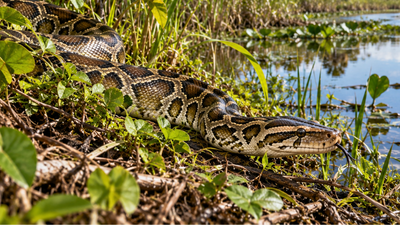
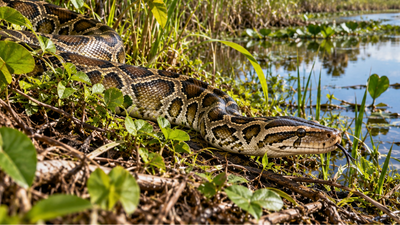
Burmese pythons, an invasive snake species linked to significant declines in native wildlife in Florida, have established a new population along the state’s Gulf Coast, raising concerns among wildlife officials about their potential spread and ecological impact. The Florida Fish and Wildlife Conservation Commission (FWC) confirmed that the snakes are established in part of western Charlotte County, north of Naples and Fort Myers, outside the species’ historically established core range. Officials believe the population may have originated from captive snakes that escaped or were deliberately released, rather than animals migrating naturally from the Everglades. Reports of pythons in the area began increasing in 2020, particularly around several residential communities. Researchers are now monitoring the population and working to remove the snakes before their impact on local ecosystems becomes more extensive.
A new Burmese python population emerges on Florida’s Gulf Coast
The newly established population is in western Charlotte County, an area that includes communities such as Rotonda West, Placida, Englewood East and South Gulf Cove. These locations are north of Naples and Fort Myers, along Florida’s Gulf Coast.For years, the state’s main Burmese python population has been concentrated in and around the Everglades, although the species has spread across a wider area of southern Florida. The newly identified population is considered a separate, or satellite, population outside that established core range.The FWC began receiving increased reports of Burmese pythons in Charlotte County in 2020. The agency now considers the snakes established in part of the county, indicating that the sightings are not simply isolated encounters with individual animals.Wildlife officials have not determined the total number of snakes in the area. However, the confirmation of an established population has raised concerns that the invasive species could spread further along the Gulf Coast.
Why experts suspect escaped or released pet snakes
Wildlife officials believe the Charlotte County population may have originated from Burmese pythons that escaped captivity or were deliberately released by pet owners.An FWC spokesperson told ABC News that there is no indication the snakes reached the county through natural migration from the Everglades. Ian Bartoszek, a wildlife biologist and science coordinator at the Conservancy of Southwest Florida, said the evidence is consistent with a satellite population established through human introduction.The precise origin of the snakes remains unknown, and officials have not identified the individuals responsible for introducing them.The wider history of Burmese pythons in Florida provides context for the concern. According to the US Fish and Wildlife Service, an estimated 180,000 Burmese pythons were imported into the United States between 1975 and 2018. Many entered the pet trade, and accidental escapes and intentional releases contributed to the species becoming established in the wild.By 2000, a self-sustaining breeding population had been established in South Florida. The new Charlotte County population has prompted concerns that similar introductions could create additional breeding areas beyond the Everglades.Florida has since placed Burmese pythons on its prohibited species list. The state also operates an Exotic Pet Amnesty Program that allows people who can no longer care for nonnative animals to surrender them without penalties.
How Burmese pythons threaten native wildlife
Burmese pythons are large, nonvenomous constrictors native to parts of South and Southeast Asia. They are generalist predators, meaning they can feed on a wide range of animals depending on what is available in their habitat.In Florida, researchers have documented pythons consuming mammals, birds and reptiles. Their prey includes raccoons, opossums, rabbits, deer and various bird species. They can also consume other reptiles, including American alligators.Their presence can disrupt ecosystems because they prey on native animals that may already face pressure from habitat loss and other environmental changes.Research in the Everglades has linked the established python invasion to substantial declines in several native mammal populations. Robert McCleery, a wildlife ecologist at the University of Florida, told ABC News that areas affected by the snakes can become simplified ecosystems in which many native mammals have declined while rodents and other invasive species persist.The full ecological impact of the newly established Charlotte County population has not yet been measured. Nevertheless, wildlife experts are concerned that the snakes could place additional pressure on native species if their numbers increase and they spread into neighbouring habitats.
Why the snakes are difficult to detect
One of the biggest obstacles to controlling Burmese pythons is their ability to remain concealed in their surroundings. Their colouring helps them blend into vegetation, while their preference for dense habitats makes them difficult to spot during surveys.Research cited by ABC News estimates that the probability of detecting a Burmese python during a survey can be as low as 1% to 3%. This means observers may find only a small fraction of the snakes present in an area.The US Fish and Wildlife Service has reported that searches in Everglades National Park encounter approximately one python for every eight hours of searching. Detection rates vary according to the location, conditions and search methods used.These challenges make it difficult for wildlife officials to estimate the total population in Florida, let alone determine the number of snakes living in the newly established Gulf Coast population.Low detection rates also complicate efforts to establish how far the snakes have spread, how many are breeding and whether their numbers are increasing.
Wildlife officials step up monitoring and removal efforts
The FWC and its partner agencies are continuing to survey for Burmese pythons in Charlotte and neighbouring Lee counties. Their work includes assessing sightings, identifying areas where the snakes are concentrated and removing animals where possible.Florida has developed several programmes to control Burmese pythons, including specialised removal teams, public training initiatives and the annual Florida Python Challenge. These efforts are intended to reduce the number of invasive snakes in the wild and improve public awareness.The state also encourages residents to report suspected Burmese python sightings through its invasive-species reporting system. The FWC advises people to photograph a suspected snake from a safe distance, record the location and report the sighting rather than attempting to handle it themselves.However, removing snakes from an established population is difficult when many individuals remain undetected. Researchers continue to investigate ways to improve detection and removal, particularly in areas where the snakes threaten vulnerable wildlife.
What remains unknown about the new population
Several questions remain unanswered about the Charlotte County population. Officials have not established how many Burmese pythons live in the area or identified the precise source of the snakes that founded the population.The extent of breeding activity is also unclear. Although the population is considered established, the available reports do not provide a confirmed count of breeding adults, nests or hatchlings.Researchers also need more evidence to determine the population’s impact on local wildlife and whether the snakes are spreading into additional parts of Florida’s Gulf Coast.The discovery highlights a broader challenge associated with invasive species. Once animals establish a self-sustaining population outside their native range, detecting and removing them can become increasingly difficult.For Florida, the priority is to understand the scale of the new population and limit its spread before it becomes harder to manage. Wildlife officials suspect escaped or released pets helped establish the Gulf Coast population, but further monitoring will be needed to establish its origins and long-term consequences.