




Headlines
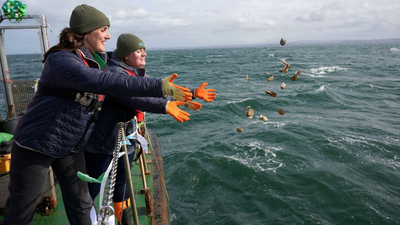
A Scottish river project set out to revive oysters that once covered an area the size of Edinburgh; now, 60,000 have been returned |

A Scottish river project set out to revive oysters that once covered an area the size of Edinburgh; now, 60,000 have been returned |

A Scottish restoration project has returned 60,000 native oysters to the Firth of Forth, reviving a species that once formed vast oyster beds across an area roughly comparable to the size of Edinburgh. The Restoration Forth partnership originally aimed to return 30,000 European flat oysters to the estuary, but the target was later doubled after…

Read More
Quote of the day by Isaac Newton: “Truth is ever to be found in simplicity, and not in the multiplicity and confusion of things" |

Quote of the day by Isaac Newton: “Truth is ever to be found in simplicity, and not in the multiplicity and confusion of things” |

Isaac Newton, one of history’s most influential scientists, spent much of his life trying to understand the laws governing the natural world. His work transformed physics, mathematics and astronomy, but his approach to discovery was rooted in careful observation, experimentation and the search for underlying principles. One of his enduring observations was that truth is…

Read More
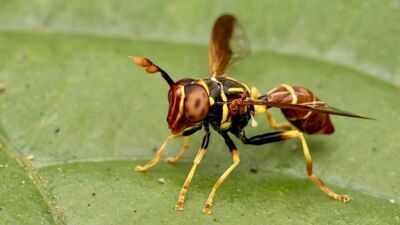
Meet Franklin Howley-Dumit Serulle, the amateur naturalist whose online insect photo helped reveal a new hoverfly species |

Meet Franklin Howley-Dumit Serulle, the amateur naturalist whose online insect photo helped reveal a new hoverfly species |

PC: Swiss Academy of Sciences A photograph shared online has helped scientists identify a hoverfly species that had remained a mystery for years. The insect, named ‘Monoceromyia ndidiae’, was photographed in the Dominican Republic and posted on iNaturalist. Its unusual appearance caught the attention of an entomologist, who began asking whether the fly represented something…

Read More
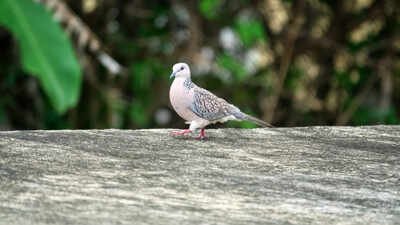
Britain’s turtle doves lost 98% of their population since the 1960s; in 2026, conservationists released 30 birds and one began laying eggs

Britain’s turtle doves lost 98% of their population since the 1960s; in 2026, conservationists released 30 birds and one began laying eggs

The European turtle dove population in the United Kingdom had fallen to just 2 percent of its peak population in the late 1960s. The species is Europe’s only migratory dove and has become the fastest-declining bird species in the U.K. As the festive season approaches, a bird forever linked with love, devotion and Christmas is…

Read More
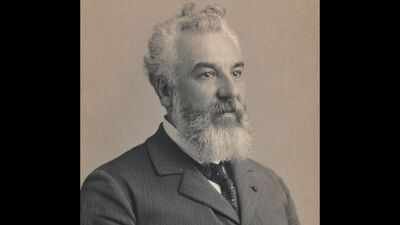
Quote of the day by Alexander Graham Bell: "Concentrate all your thoughts on the task at hand. The sun's rays do not burn until…" - lesson about turning potential into results |

Quote of the day by Alexander Graham Bell: “Concentrate all your thoughts on the task at hand. The sun’s rays do not burn until…” – lesson about turning potential into results |

Quote of the day by Alexander Graham Bell (Image: Wikipedia) In an age of constant notifications, endless open tabs and competing priorities, Alexander Graham Bell’s words feel genuinely surprising in how modern they still sound. “Concentrate all your thoughts on the task at hand,” he said. “The sun’s rays do not burn until brought to…

Read More
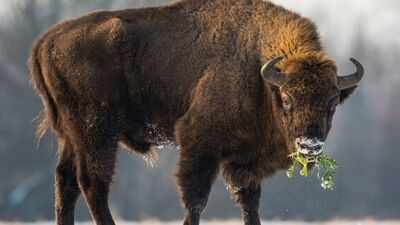
In 1987, Kansas brought 30 bison back to Konza Prairie; 29 years later, native plant richness had risen 103% locally and 86% across catchments

In 1987, Kansas brought 30 bison back to Konza Prairie; 29 years later, native plant richness had risen 103% locally and 86% across catchments

Restoring grazing by native large herbivores such as bison can produce sustained increases in native plant diversity In 1987, 30 bison from the Fort Riley Military Reservation were brought to Konza Prairie in Kansas. Nearly three decades later, researchers found that native plant species richness had increased by 103% at the local scale and by…

Read More
Singapore covered a reservoir with 122,000 floating solar panels; it now powers 5 water-treatment plants and cuts 32,000 tonnes of CO₂ every year |

Singapore covered a reservoir with 122,000 floating solar panels; it now powers 5 water-treatment plants and cuts 32,000 tonnes of CO₂ every year |

Singapore has turned part of a reservoir into a giant renewable-energy installation, covering about one-third of Tengeh Reservoir with more than 122,000 floating solar panels spread across 10 floating islands. The 45-hectare Sembcorp Tengeh Floating Solar Farm has a capacity of 60 MWp and generates electricity used to support five local water-treatment plants. The project…

Read More
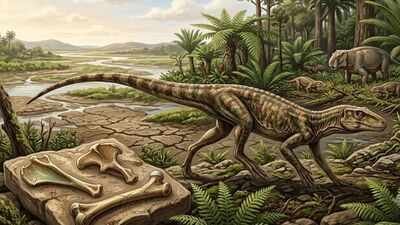
A 240-million-year-old fossil disappeared for 20 years, then its rediscovery revealed a new reptile related to dinosaurs and crocodiles |

A 240-million-year-old fossil disappeared for 20 years, then its rediscovery revealed a new reptile related to dinosaurs and crocodiles |

A fossil found in southern Brazil is giving researchers a closer look at the reptiles that lived near the beginning of the archosaur lineage, the group that would eventually include dinosaurs and crocodile-line animals. The animal has been named ‘Silescelida acristata’ and is identified as an early-diverging eucrocopodan archosauriform from the Middle Triassic. A recent…

Read More
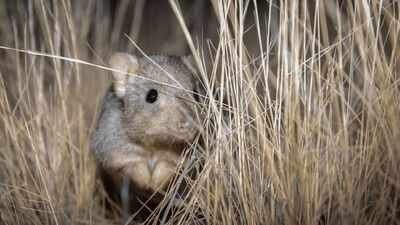
Australia brought digging mammals back to an 8,000-hectare sanctuary; 8 years later, scientists found they had reshaped underground insect communities |

Australia brought digging mammals back to an 8,000-hectare sanctuary; 8 years later, scientists found they had reshaped underground insect communities |

Image Credit: Brad Leue/AWC Australia’s effort to bring digging mammals back to an 8,000-hectare wildlife sanctuary has produced changes below the surface. Researchers studying Scotia Sanctuary in south-eastern Australia found that 8 years after reintroduced mammals were given access to areas, the communities of insects emerging from the soil had changed. The mammals, including greater…

Read More
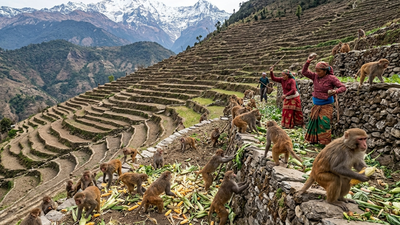
Nepal’s farmers built terraces into steep Himalayan slopes; now growing macaque populations are making it harder to keep their harvests |

Nepal’s farmers built terraces into steep Himalayan slopes; now growing macaque populations are making it harder to keep their harvests |

Nepal’s mid-hills are places where farming has long meant working with the landscape rather than against it. Terraces cut into steep slopes turn difficult ground into fields for maize, millet, rice and other crops, with generations of farmers maintaining the walls and soil that make cultivation possible. But the balance between people, farmland and wildlife…

Read More
Scientists found an unexpected second product while making cleaner hydrogen; the leftover material was high-quality graphite |

Scientists found an unexpected second product while making cleaner hydrogen; the leftover material was high-quality graphite |

Liquid hydrogen Tank at NASA Kennedy Space Center. Image Credit: US Department of Energy Scientists working on a cleaner way to produce hydrogen have discovered an unexpected second product which is high-quality graphite. The finding emerged from research into methane pyrolysis, a process that splits methane into hydrogen and solid carbon instead of producing CO2…

Read More
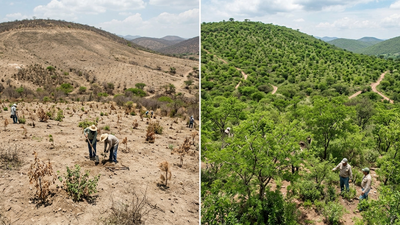
In 2014, Mexico began a massive 1 million-hectare restoration drive; 4 years later plant survival had risen from just 33% to 64% |

In 2014, Mexico began a massive 1 million-hectare restoration drive; 4 years later plant survival had risen from just 33% to 64% |

Restoring damaged land can look straightforward on paper: plant trees, repair soils and wait for vegetation to return. On the ground, the work is less predictable. Young plants have to survive drought, poor soils, fire, grazing and the other pressures that caused landscapes to deteriorate in the first place.Mexico’s National Forestry Commission, known as CONAFOR,…

Read More