






Headlines
240,000 miles from Earth, Nasa is building the world’s first ‘space airport’ for the Moon, where spacecraft will have to queue for weeks to avoid traffic |

240,000 miles from Earth, Nasa is building the world’s first ‘space airport’ for the Moon, where spacecraft will have to queue for weeks to avoid traffic |

Nearly 240,000 miles from Earth, Nasa is preparing a new kind of transportation hub where spacecraft could one day arrive, wait, dock and depart without a single runway, road or parking bay. The Gateway space station, planned for lunar orbit as part of the Artemis programme, is expected to host Orion crew capsules, lunar landers…

Read More
MIT scientists watched electrons rebuild inside a quantum material; one phase grew like an ice crystal |

MIT scientists watched electrons rebuild inside a quantum material; one phase grew like an ice crystal |

Deep inside a crystal cooled to nearly -230°C, MIT physicists have caught something rarely seen in quantum materials: two populations of electrons rebuilding themselves into wave-like order after being scattered apart by laser light, and doing so in two completely different ways. Working with erbium tritelluride, a rare-earth material known for hosting a pair of…

Read More
In 2007, only 6 Galápagos snapdragons were known to survive on remote lava fields; after conservationists planted 94 nursery-grown shrubs, the wild adult population has grown to 28

In 2007, only 6 Galápagos snapdragons were known to survive on remote lava fields; after conservationists planted 94 nursery-grown shrubs, the wild adult population has grown to 28

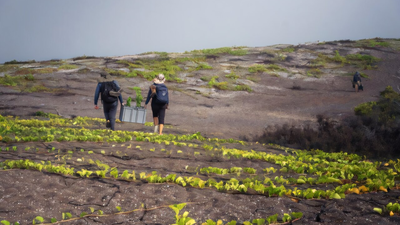
Researchers transporting Galvezia leucantha subsp. Leucantha at the restoration site, preparing for its planting A critically endangered shrub that once came close to disappearing from the Galápagos Islands is showing signs of a slow but important recovery after a careful conservation effort lasting nearly three decades. According to findings published in the journal Nature Conservation…

Read More
In 2002, a NASA intern stole a 600-pound safe containing $21 million in Moon rocks to give his girlfriend, then an online sale led him into an FBI trap |

In 2002, a NASA intern stole a 600-pound safe containing $21 million in Moon rocks to give his girlfriend, then an online sale led him into an FBI trap |

The Moon has been romanticised for centuries, but few people have ever tried to give someone a piece of it. In 2002, that idea became part of an extraordinary theft at Nasa’s Johnson Space Center, where an intern helped remove a safe containing Apollo lunar samples and other irreplaceable scientific material. The stolen collection included…

Read More
An invasive beetle wiped out black ash trees across parts of North America; scientists germinated 22,000 seeds, including genetic material from tree populations that no longer survive in the wild

An invasive beetle wiped out black ash trees across parts of North America; scientists germinated 22,000 seeds, including genetic material from tree populations that no longer survive in the wild

An invasive beetle wiped out black ash trees across parts of North America Researchers have created a living seed bank to protect North America’s endangered black ash trees from extinction after decades of damage from an invasive insect. Led by scientists at Pennsylvania State University, the conservation project has successfully germinated 22,000 black ash seeds…

Read More
Meet Aashritha Penumudi, the 17-year-old Virginia student who created stalled ribosomes in the lab and trained AI on breast-cancer data; its predictions matched what she saw under the microscope

Meet Aashritha Penumudi, the 17-year-old Virginia student who created stalled ribosomes in the lab and trained AI on breast-cancer data; its predictions matched what she saw under the microscope

Aashritha Penumudi (Thomas Jefferson High School for Science and Technology, Alexandria, VA) By combining laboratory biology with machine learning, a 17-year-old student from Virginia has gained new insights into how protein production can go wrong in cancer cells. Aashritha Penumudi, a senior at Thomas Jefferson High School for Science and Technology in Alexandria, studied a…

Read More
Meet Alyssa Yu, the 17-year-old Maryland student who built a mathematical model for what happens when 2 interacting infections spread at once and how vaccination could target the resulting hot spots

Meet Alyssa Yu, the 17-year-old Maryland student who built a mathematical model for what happens when 2 interacting infections spread at once and how vaccination could target the resulting hot spots

Alyssa Yu (Poolesville High School, Poolesville, MD) A 17-year-old student from Maryland has developed a new mathematical framework to predict how multiple infectious diseases interact and spread through connected populations at the same time. Alyssa Yu, a senior at Poolesville High School in Montgomery County, created the computer model to address a major gap in…

Read More
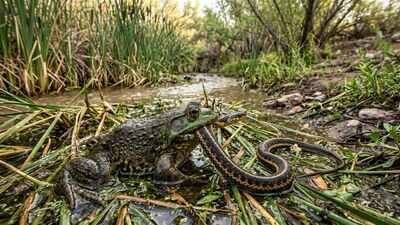
In 1920, Arizona introduced bullfrogs as a game species and food source; a century later, the invasive frogs are threatening the Northern Mexican gartersnake |

In 1920, Arizona introduced bullfrogs as a game species and food source; a century later, the invasive frogs are threatening the Northern Mexican gartersnake |

A pond in southern Arizona can look quiet from a distance. Beneath the surface, though, the balance between species can be very different from what it was a century ago. Among the animals affected is the northern Mexican gartersnake, a wetland-dependent reptile that hunts along streams, ponds and cienegas across parts of the Southwest.Its decline…

Read More
The human brain usually decays first after death, so how have thousands survived for 12,000 years? Scientists uncover the chemistry behind the mystery

The human brain usually decays first after death, so how have thousands survived for 12,000 years? Scientists uncover the chemistry behind the mystery

Representative Image (Canva) The human brain is one of the first organs to break down after death, making the discovery of preserved brains at archaeological sites particularly puzzling. Yet thousands of ancient human brains have survived long after other soft tissues disappeared, sometimes remaining as the only preserved soft tissue in otherwise skeletonised remains. New…

Read More
In 2017, an MIT class project explored a new kind of aircraft; it has now grown into an $850 million Ohio factory plan for an 8-motor hybrid plane that can take off from an area about the length of a soccer field

In 2017, an MIT class project explored a new kind of aircraft; it has now grown into an $850 million Ohio factory plan for an 8-motor hybrid plane that can take off from an area about the length of a soccer field

Electra takes a different approach to hybrid aviation. Instead of a traditional engine operating the propellers, the aircraft has a gas-powered generator in the nose. (Image: MIT News) A class project at the Massachusetts Institute of Technology (MIT) in 2017 studied a new type of aircraft; now, it has ballooned into a $850 million Ohio…

Read More
A cooling film developed at the University of Illinois was tested on Houston infrastructure for FIFA; treated metal roofs stayed over 40°F cooler in direct sunlight without using electricity |

A cooling film developed at the University of Illinois was tested on Houston infrastructure for FIFA; treated metal roofs stayed over 40°F cooler in direct sunlight without using electricity |

In Houston, the heat is part of the setting. During the FIFA Fan Festival, though, some of the infrastructure around the event had a rather different experience of the Texas summer. Roofs treated with a thin cooling film stayed dramatically cooler than nearby untreated metal surfaces, even while sitting beneath direct sunlight.The material was not…

Read More