










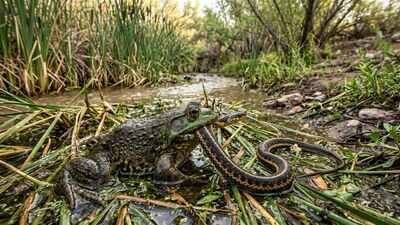
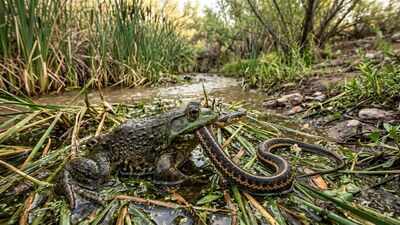
A pond in southern Arizona can look quiet from a distance. Beneath the surface, though, the balance between species can be very different from what it was a century ago. Among the animals affected is the northern Mexican gartersnake, a wetland-dependent reptile that hunts along streams, ponds and cienegas across parts of the Southwest.Its decline has several causes, including habitat loss and changes to waterways. But one of the most persistent problems arrived deliberately. As reported by Tucson Herpetological Society, beginning in the 1920s, Arizona wildlife officials introduced American bullfrogs into lakes and rivers as a potential source of food for hunters and anglers. Stocking continued for decades. The frogs established themselves, spread into new wetlands and became predators in places where the native snake had evolved without them.
How bullfrogs became an Arizona problem
American bullfrogs belong naturally to the eastern United States, with their native range extending roughly as far west as the Rocky Mountains.The introduction was driven by a fairly straightforward idea. Bullfrogs were already valued elsewhere as a source of frog legs, and wildlife officials hoped they could provide another species for people to catch. From the 1920s through at least 1982, bullfrogs were stocked in parts of Arizona, according to the Tucson Herpetological Society.At the time, the wider consequences of moving the species into unfamiliar ecosystems were not fully understood. Bullfrogs are large compared with many native amphibians, reproduce in considerable numbers and can tolerate a variety of wetland conditions. Once established, they are difficult to remove. That combination has proved troublesome in Arizona.
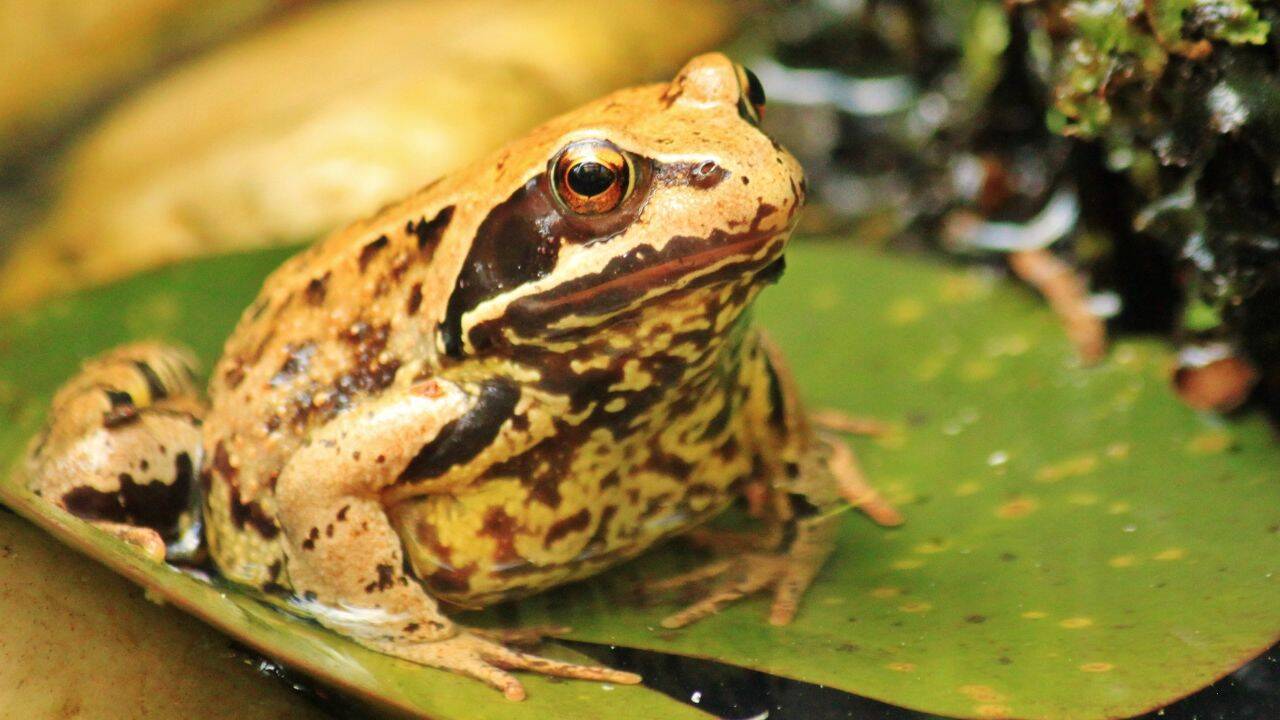
Young gartersnakes face a growing threat from adult bullfrogs
Northern Mexican gartersnakes are closely tied to wetlands. They are generally found around streams, ponds, springs and cienegas, where they hunt along the edges of the water. Their diet includes frogs and small fish, so the arrival of bullfrogs created more than one problem. Young bullfrogs compete with native animals for food and other resources, while adult bullfrogs are large enough to eat a wide range of prey.The numbers involved in bullfrog reproduction make the imbalance particularly difficult to correct. A female can produce roughly 20,000 eggs in a single breeding event, according to National Geographic. Native predators do not necessarily consume enough tadpoles to keep those populations in check.The relationship is not entirely one-sided. Northern Mexican gartersnakes can eat some bullfrog larvae and young frogs. That predation, however, does not appear to compensate for the number of young gartersnakes that adult bullfrogs can consume. For a snake already living in an increasingly fragmented habitat, that difference matters.
How bullfrogs are threatening young gartersnakes
Adult bullfrogs are opportunistic predators. Their prey can include other amphibians, reptiles, birds and small mammals, as well as insects and fish.Northern Mexican gartersnakes are particularly vulnerable while they are young. A juvenile snake is small enough to become prey itself, potentially disappearing from the population before it reaches reproductive age.This creates a problem that is less visible than simply counting adult snakes. A wetland might still contain gartersnakes, yet have trouble producing enough young animals to replace those that die.Federal assessments indicate that the species has disappeared from, or fallen to very low numbers across, roughly 90% of its former US range. In Arizona and New Mexico, remaining populations are scattered rather than forming the broader network of populations that once occupied suitable wetlands.
Bullfrogs can travel miles between wetlands, making local removal difficult to sustain
Removing bullfrogs from a single wetland might seem like a manageable task. The difficulty comes when frogs from elsewhere can simply move back in.Bullfrogs are surprisingly mobile. In one example cited by National Geographic, young frogs tagged near Arizona’s Buenos Aires National Wildlife Refuge travelled more than six miles within weeks.Research supported by the US Fish and Wildlife Service recorded a maximum straight-line movement of about 6.3 miles over a year in southeastern Arizona. Some unmarked frogs were found almost eight miles from ponds thought to be their likely starting points.Wet weather can make that movement easier. Small pools and temporary ponds create stepping stones between larger wetlands, allowing frogs to occupy new sites rather than remaining confined to the place where they were first introduced.
Removing an established population takes work
Since the 1990s, conservation teams, state wildlife agencies and federal partners have worked to reduce bullfrog numbers at sites important to native species.The methods are not especially high-tech. Crews can use nets and traps to catch frogs, while some wetlands or artificial stock tanks can be drained to remove animals and prevent them from reproducing there.In some locations, the effort has produced measurable results. At the Cienega Creek complex, bullfrogs were successfully eradicated in 2013. Native leopard frog populations subsequently increased there, according to the US Fish and Wildlife Service.