





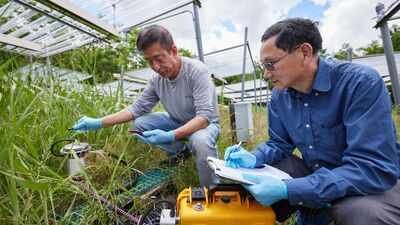
Scientists ran a 12-year grassland experiment in Oklahoma and found that warming cut soil carbon by 12.2% under drought but raised it by 6.7% in wet conditions |

Scientists ran a 12-year grassland experiment in Oklahoma and found that warming cut soil carbon by 12.2% under drought but raised it by 6.7% in wet conditions |

PC: Travis Caperton/University of Oklahoma Soil stores more than three times the carbon found in the atmosphere, making it an important part of Earth’s carbon cycle. However, rising temperatures can affect how much carbon remains in the ground. A 12-year field experiment at the University of Oklahoma has found that rainfall plays a critical role…
Read More
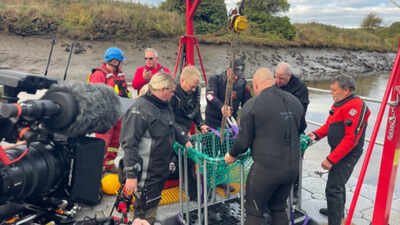
A diver searching the bottom of England’s River Wear has pulled up a huge three-legged iron cauldron that lay hidden underwater for hundreds of years, and researchers are still trying to work out how it got there

A diver searching the bottom of England’s River Wear has pulled up a huge three-legged iron cauldron that lay hidden underwater for hundreds of years, and researchers are still trying to work out how it got there

(Image credit: Facebook/ Gary Bankhead) A whole world of material culture, ruling dynasties, and the history of communities and their elusivity is etched in the world around us, in the buildings and the roads. But beneath it all, deep-seated in our rivers, lies the archive of its own history—the world that survived before us. So,…

Read More
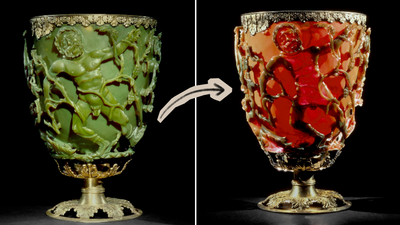
A 1,600-year-old Roman cup turns green or ruby red depending on how light hits it; after years of experiments, Sheffield researchers have recreated the glass effect using tiny gold and silver particles

A 1,600-year-old Roman cup turns green or ruby red depending on how light hits it; after years of experiments, Sheffield researchers have recreated the glass effect using tiny gold and silver particles

Photo credit: The British Museum A drinking cup made around 1,600 years ago has a remarkable property: it can appear green when light falls on it and ruby red when light shines through it. Now, researchers at the University of Sheffield have recreated the unusual glass effect, offering a new understanding of the technique used…

Read More
Rock that sank over 90 kilometres into Earth reveals a sharp shift in thermal gradient, challenging ideas about heat in subduction zones |

Rock that sank over 90 kilometres into Earth reveals a sharp shift in thermal gradient, challenging ideas about heat in subduction zones |

PC: University of Göttingen A rock found on Goodenough Island in Papua New Guinea has preserved evidence of an unexpected change in thermal gradient as it sank deep beneath Earth’s surface. Researchers estimate that the rock travelled more than 90 kilometres into a subduction zone about 4.4 million years ago. Its mineral record indicates that…

Read More
A community in South Australia’s first dark-sky reserve is opposing a proposed hyperscale data centre; residents fear the development could change the rural landscape and threaten the darkness that draws visitors

A community in South Australia’s first dark-sky reserve is opposing a proposed hyperscale data centre; residents fear the development could change the rural landscape and threaten the darkness that draws visitors

A community in South Australia’s first dark-sky reserve is opposing a proposed hyperscale data centre (Image Source: Canva) “For my part, I know nothing with any certainty, but the sight of the stars makes me dream.” Vincent van Gogh wrote this in one of his letters to his brother Theo in 1888. More than a…

Read More
Pennsylvania researchers tracked fruit flies across 10 generations, revealing how changing seasons influence genetic variation and reverse evolutionary adaptations |

Pennsylvania researchers tracked fruit flies across 10 generations, revealing how changing seasons influence genetic variation and reverse evolutionary adaptations |

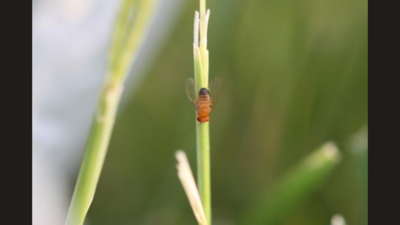
PC:  University of Pennsylvania Scientists at the University of Pennsylvania tracked 10 fruit fly populations in outdoor enclosures for four months, documenting rapid genetic changes as the seasons shifted from summer to autumn. The experiment, conducted in Pennsylvania in 2014, found that natural selection influenced genetic variant frequencies at more than 60% of sites across…

Read More
Hawaii turns abandoned fishing nets into electricity to power over 300 homes while fighting ocean pollution and protecting marine wildlife |

Hawaii turns abandoned fishing nets into electricity to power over 300 homes while fighting ocean pollution and protecting marine wildlife |

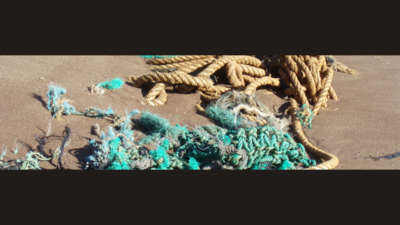
Abandoned fishing nets that once threatened marine life around Hawaii are being turned into electricity through a programme established in 2002. The Hawaii Nets to Energy Program collects discarded nets from fishermen and local removal groups before processing them for combustion at Honolulu’s H-Power waste-to-energy facility. According to NOAA Ocean Today, 832 tons of fishing…

Read More
Mark Zuckerberg's wife Priscilla Chan-backed Biohub researchers used AI and CRISPR to identify new psoriasis drug targets; topical gels successfully  worked in mice
 |

Mark Zuckerberg’s wife Priscilla Chan-backed Biohub researchers used AI and CRISPR to identify new psoriasis drug targets; topical gels successfully  worked in mice
 |

Mark Zuckerberg with his wife Priscilla Chan in 2014. Image Credit: Wikipedia Researchers at Biohub, an organisation backed by the Chan Zuckerberg Initiative co-founded by Priscilla Chan, have identified potential new drug targets for psoriasis by combining AI with genetic screening. The study, published in Nature Communications, discovered 2 biological pathways that could help control…

Read More
Do spiders dream? Researchers studying Australian jumping spiders have found sleep patterns resembling REM sleep, raising new questions about dream-like states in invertebrates

Do spiders dream? Researchers studying Australian jumping spiders have found sleep patterns resembling REM sleep, raising new questions about dream-like states in invertebrates

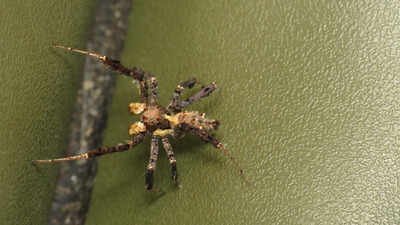
(Image credit: Wikimedia Commons) Dreaming is an experience we often associate with humans but is it something that only humans experience? Scientists have long been curious to ascertain what may happen when other animals fall asleep. While certain sleep behaviours have been observed in mammals and birds, much less is known about how sleep works…

Read More
Clocks go back one hour this Sunday, November 1, as daylight saving time ends across most of the US; here is why the extra hour of sleep can still leave you feeling tired for days, and what sleep experts suggest doing about it

Clocks go back one hour this Sunday, November 1, as daylight saving time ends across most of the US; here is why the extra hour of sleep can still leave you feeling tired for days, and what sleep experts suggest doing about it

Millions of Americans will gain an extra hour on Sunday, November 1, when daylight saving time ends and clocks go back by one hour. But while the change may appear to offer a welcome chance to sleep longer, it can still leave some people feeling tired, groggy or out of step with their usual routine…

Read More
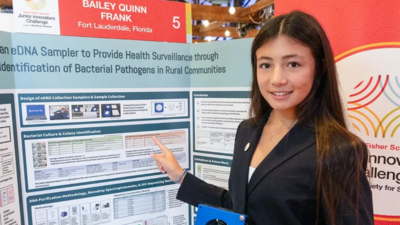
Meet Bailey Quinn Frank, 15, from Fort Lauderdale, who built an air sampler with a small fan and filter paper to collect bacterial DNA; she has now won a $25,000 science prize among nearly 2,000 applicants

Meet Bailey Quinn Frank, 15, from Fort Lauderdale, who built an air sampler with a small fan and filter paper to collect bacterial DNA; she has now won a $25,000 science prize among nearly 2,000 applicants

Bailey Quinn Frank, 15, from Fort Lauderdale, who built an air sampler with a small fan and filter paper to collect bacterial DNA (Image Credit: Society For Science) A 15-year-old student from Fort Lauderdale, Florida, has won a $25,000 science award for developing an affordable device that collects airborne bacterial DNA, with the potential to…

Read More
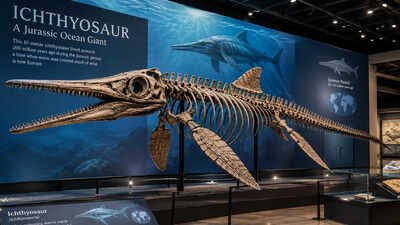
A 10-metre ichthyosaur discovered on a secret Dorset beach has gone on display; Bristol researchers estimate the Jurassic marine reptile is about 174 million years old |

A 10-metre ichthyosaur discovered on a secret Dorset beach has gone on display; Bristol researchers estimate the Jurassic marine reptile is about 174 million years old |

Representative Image of a 10-meter ichthyosaur fossil displayed in a museum, highlighting its significance during the Jurassic period (AI-generated image) A 10-metre ichthyosaur discovered on a secluded beach near Bridport in Dorset has gone on display at Bridport Museum, bringing an unusual Jurassic fossil into public view. Belgian fossil hunters Michel Plissart and his partner…

Read More