





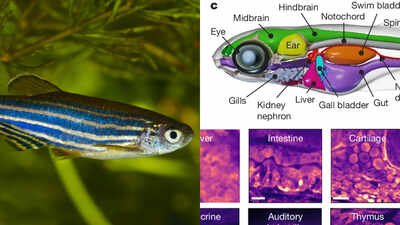
Scientists built a system that watches activity across nearly every cell of a living vertebrate at once; transparent zebrafish revealed body-wide signals moving between organs

Scientists built a system that watches activity across nearly every cell of a living vertebrate at once; transparent zebrafish revealed body-wide signals moving between organs

The system is called WHOLISTIC, short form for Whole Organism Live Imaging System for recording Tissue and IntraCellular activity. The body is never truly quiet. Even when an animal appears to be resting, billions of cells are sending signals, responding to changes and coordinating with organs far beyond their immediate surroundings. For scientists, the challenge…
Read More
Scientists drilled nearly 1 kilometre into an Antarctic glacier and found meltwater can make the ice suddenly move 20% faster |

Scientists drilled nearly 1 kilometre into an Antarctic glacier and found meltwater can make the ice suddenly move 20% faster |

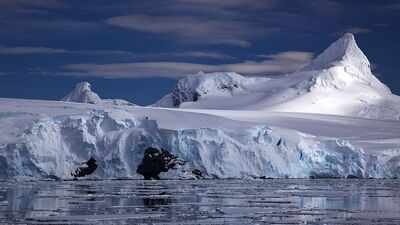
Glacier in Antarctica. Image Credit: Jason Auch/Wikipedia Scientists have directly linked surface meltwater to a sudden increase in the speed of an Antarctic glacier, after drilling deep into Langhovde Glacier in East Antarctica. The study titled ‘Acceleration of an Antarctic outlet glacier driven by surface meltwater input to the base,’ found that water from melting…

Read More
Archaeologists found a shellfish-covered island in Fiji dating back 1,200 years, possibly created by ancient food processing |

Archaeologists found a shellfish-covered island in Fiji dating back 1,200 years, possibly created by ancient food processing |

PC: Study: Shell-Dense Island Off Culasawani, Vanua Levu Island, Fiji: Midden or Muddle? Archaeologists investigating Fiji’s Vanua Levu have identified a small coastal island whose sediments are made up largely of discarded shellfish remains. The site, near Culasawani on the island’s north coast, covers about 3,000 square metres and contains a shell-rich deposit that makes…

Read More
Scientists turned coconut waste into a water-cleaning material. It removed 95.5% of textile dye in 80 minutes |

Scientists turned coconut waste into a water-cleaning material. It removed 95.5% of textile dye in 80 minutes |

Coconut Husk. Image Credit: Wikimedia Commons Royal Society of Chemistry(RSC) Advances published a study which found that green coconut husk waste could remove 95.5% of Congo red dye from water within 80 minutes. The researchers modified the coconut-derived lignin by adding nitrogen-containing groups, creating what they called aminated lignin. Under the best conditions tested, only…

Read More
A school-led project helped bring back a lost kelp forest; 15,000 students and 250 divers later became part of the restoration effort |

A school-led project helped bring back a lost kelp forest; 15,000 students and 250 divers later became part of the restoration effort |

A diver in a kelp forest off the coast of California. Image Credit: Ed Bierman/Wikipedia A school-led restoration project in Orange County, California, has helped bring back kelp forests while turning thousands of students into active participants in marine conservation. Since 2009, the organisation ‘Get Inspired’ has involved schools and volunteer scuba divers in efforts…

Read More
In 2019, scientists shook earthworms to study their movements and found strange waves at half the frequency, winning a strange science prize |

In 2019, scientists shook earthworms to study their movements and found strange waves at half the frequency, winning a strange science prize |

In an experiment, scientists shook living earthworms at high frequencies to see how their flexible bodies responded to vibration. What they found was unexpected: the worms developed waves that oscillated at half the frequency of the force driving them. According to the 2019 study published in Nature, titled ‘Excitation of Faraday-like body waves in vibrated…

Read More
In 1870, goats were left on a tiny Seychelles island; 50 years later, conservationists had to eradicate them to save its native ecosystem |

In 1870, goats were left on a tiny Seychelles island; 50 years later, conservationists had to eradicate them to save its native ecosystem |

A feral goat. Image Credit: Scott Bauer/Wikimedia commons The introduction of goats to Seychelles islands created a long-term conservation problem, with one of the earliest eradication efforts recorded on Aride Island in 1920. The study titled ‘Introduced mammals on Western Indian Ocean islands’ documents how introduced mammals became targets of conservation programmes across the Western…

Read More
African elephants are raiding small farms in Tanzania; a new study found when and why most crop attacks happen |

African elephants are raiding small farms in Tanzania; a new study found when and why most crop attacks happen |

Elephant in Tanzania. Image Credit: Nevit Dilmen/Wikimedia Commons In parts of Tanzania, small farms are increasingly coming into contact with African elephants, leading to a hard conflict between wildlife conservation and rural livelihoods. A 2026 study, published in the ‘International Journal of Biodiversity and Conservation’ found that most of the reported crop raids in the…

Read More
Charles Darwin: Quote of the day by Charles Darwin: “A man who dares to waste one hour of time has not discovered the value of life” |

Charles Darwin: Quote of the day by Charles Darwin: “A man who dares to waste one hour of time has not discovered the value of life” |

Charles Darwin, the English naturalist whose theory of evolution by natural selection transformed our understanding of life, also left behind observations that extended beyond biology. One of his most memorable reflections was on the value of time and how people choose to use it. His words, “A man who dares to waste one hour of…

Read More
This snake grows a fake spider on its tail to lure birds; scientists scanned the bizarre appendage and found surprisingly normal bones inside

This snake grows a fake spider on its tail to lure birds; scientists scanned the bizarre appendage and found surprisingly normal bones inside

Spider-tailed horned viper (Image Credit: Omid Mozaffari) The natural world is full of animals that use mimicry to survive, but few examples are as unusual as the spider-tailed horned viper. Native to Iran, this elusive snake has evolved a remarkable tail tip that resembles a spider, complete with a bulbous body and dangling, leg-like structures….

Read More
Malaysian students built a device that turns wastewater from sinks into electricity; the system stores intermittent flow and powers a tiny turbine |

Malaysian students built a device that turns wastewater from sinks into electricity; the system stores intermittent flow and powers a tiny turbine |

Malaysian students have built a prototype that attempts to recover electricity from one of the most overlooked sources of wasted energy in a home, water flowing down the sink. Developed by three students at Universiti Malaya, WattsUp is an IoT-enabled micro-hydropower system designed specifically for the weak and intermittent flow produced by household wastewater. Rather…

Read More
In 1902, Hawaii introduced red mangroves to stabilize shorelines; 124 years later, the invasive trees clog waterways and degrade habitat used by endangered native waterbirds

In 1902, Hawaii introduced red mangroves to stabilize shorelines; 124 years later, the invasive trees clog waterways and degrade habitat used by endangered native waterbirds

Representative image of Hawaii from Canva In 1902, red mangroves were brought to Hawaii with an apparently practical purpose. Their tangled roots could hold soil in place, reduce erosion and stabilise shorelines around vulnerable coastal areas. At the time, the trees seemed like a useful solution for an island environment shaped by waves, storms and…

Read More