









Burmese pythons were once among the exotic pet species in the US, and today they are among the most talked-about invasive species in South Florida, slithering through the Everglades wetlands and influencing the food chain as they go.But how did it happen?Native to Southeast Asia, Burmese pythons were brought to the US in large numbers through the pet trade. But by the 1980s, some had escaped, while others were released and settled in South Florida. The warm, wet Everglades suited them well.But it all came down to their diet. A 2012 study in the journal PNAS associated the python spread with steep declines in raccoons, opossums, and bobcats in Everglades National Park.Pythons grow large, breed well, and have very few natural enemies, which is why numerous researchers are working to find ways to slow them down. Hunters, tracking snakes, and removing eggs all look forward to reducing the Burmese python numbers, yet the problem remains huge.Burmese pythons have very few natural enemies in South Florida, so even a small sign of progress comes to light. University of Florida researchers have now reported that vultures are feeding on a python nest in the Everglades and it could be helpful in bringing down their numbers
Vultures could help bring down Burmese pythons’ numbers in Florida
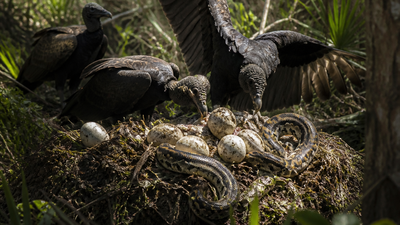
According to a study published earlier this year in the journal Reptiles & Amphibians, a tagged female python was found brooding her eggs on 5 May 2023 in the Francis S. Taylor Wildlife Management Area, part of the greater Everglades ecosystem. Her nest was hidden under a thick layer of grass. When the team returned on 6 June, at least four vultures were eating the eggs, CBS News reported. The birds flew off before they could be identified, though Black Vultures and Turkey Vultures are both common in the area.
The nest was heavily disturbed and exposed
The nest was heavily disturbed, with the grass pulled back and the egg cavity exposed. Researchers counted at least 17 eggs. Three had been dragged out, leaving only shell pieces, while the other 14 stayed in the nest but were punctured, their contents exposed or gone.There was no fur, scales, tracks, or scat to suggest another predator, and the puncture marks fit a vulture’s beak. Because the eggs were hidden, the researchers believe the birds found them by smell.
Where was the mother?
The female python was later found in shallow water about 40 feet from the nest. Females rarely leave their eggs while brooding, and them simply being there helps guard against predators.The researchers offer two likely explanations: the vultures or another disturbance drove her away, or she stepped out briefly, and the birds took the chance. Which one is true remains unclear.
This is the first noted instance of the native birds preying on the Burmese pythons
The authors describe it as “the first recorded instance” of a native bird preying on a Burmese python nest in Florida, even though other animals have raided nests before. A 2022 study in Ecology and Evolution photographed a bobcat raiding an unguarded python nest, which USGS describes as the first documentation of any animal in Florida preying on python eggs.