









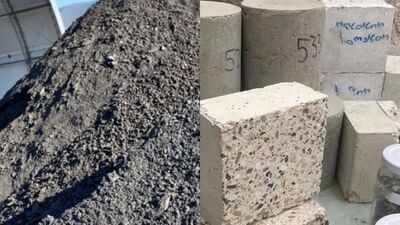
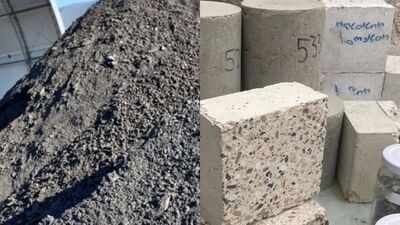
Germany produces around 6 million tonnes of ash from municipal waste incineration every year, leaving behind a substantial residue that requires careful treatment. Researchers are now investigating whether this material can serve a useful purpose beyond waste management. A project involving TH Köln(Cologne University of Applied Sciences) and RWTH Aachen University is testing methods to make the ash absorb and permanently retain carbon dioxide, potentially transforming it into a resource for road construction and concrete production. The approach could also reduce the need for construction materials extracted through energy-intensive processes.
How Germany is turning waste ash into a carbon-storing construction material
The research centres on bottom ash, the mineral-rich residue left after municipal waste is burned. Although it contains materials that could be useful in construction, untreated incineration ash is considered hazardous because it can contain heavy metals, toxic dioxins, furans and soluble salts, according to Engineers Ireland.The residue is therefore not directly suitable for use in building projects. Before it can become a potential construction resource, it must undergo processing to recover metals and remove unwanted contaminants.TH Köln explains that specialised facilities already handle this material through metal recovery, screening and sorting. These steps produce a cleaned ash that can be examined for further applications.The researchers are now exploring whether the mineral components in this processed residue can also help address CO2 emissions. The idea is to use the ash’s natural ability to react with carbon dioxide, creating a material that stores the gas while potentially serving another industrial purpose.
Carbonation offers a way to bind carbon dioxide permanently
The central process being investigated is carbonation, a chemical reaction in which minerals within the ash absorb carbon dioxide and bind it into a more stable form.According to TH Köln, the mineral content of the processed ash can take up carbon dioxide and retain it permanently. Researchers want to develop a practical method for making this reaction work efficiently outside laboratory conditions.The project is led by the Bergischer Abfallwirtschaftsverband, or BAV, with TH Köln and RWTH Aachen University participating as scientific partners. The industrial partner refer GmbH is supplying processed incineration ash from its treatment facility.The work is part of KARMA, a project focused on carbonation of waste-incineration ash. The initiative secured funding through North Rhine-Westphalia’s CCU model regions competition and will receive more than one million euros in support until mid-2028. CCU refers to capturing carbon dioxide and putting it to use rather than simply releasing it into the atmosphere.
Which carbonation method can capture more carbon
A major part of the research involves comparing two different ways of bringing carbon dioxide into contact with the ash. The methods differ in how much moisture they use and how effectively the gas can penetrate the material.The first method is wet carbonation, where the ash is processed in water. This method allows for more CO2 absorption, but it needs energy. Then the material has to be dried, which may affect the overall efficiency of the process.The second way is to use limited moisture. In this method a carbonated layer is formed on the surface of the ash. But the layer can get quite dense and keep carbon dioxide from getting deeper into the material. This means less gas is being stored.”These trade-offs were outlined by Axel Wellendorf of TH Köln, who explained that both approaches have advantages and disadvantages. The researchers need to determine which method offers the most suitable balance between carbon uptake and the energy required to process the material.
A test facility will compare the different approaches
To move the research beyond lab experiments, the partners are developing a technical test facility at the Leppe waste disposal centre near Lindlar in Germany.The facility is being established by TH Köln and RWTH Aachen University and will be operated by BAV, which leads the project. The processed ash supplied by refer GmbH will provide the starting material for experiments.The planned facility will allow the researchers to adjust and compare different carbonation methods under conditions closer to practical industrial use.Engineers Ireland reports that the project is intended to develop a flexible pilot system capable of testing the processes under realistic conditions. The researchers will first evaluate how the ash reacts with carbon dioxide before examining whether the resulting material can meet construction requirements.
Could carbonated ash replace sand and gravel in roads
One of the possible applications is road construction, where carbonated ash could be used in an unbound form. This means the material would not necessarily need to be incorporated into concrete or another binding mixture before being used.TH Köln says the processed ash could potentially replace gravel or sand in road construction and earthworks. These materials are commonly obtained through extraction, which can require considerable energy.By using carbonated ash instead, the project hopes to substitute some of these conventional raw materials with a residue that would otherwise require further management.The researchers are also examining whether the material could be suitable for concrete production. In this application, the ash could potentially function as a binder rather than simply replacing aggregates such as sand or gravel.But concrete production places stricter demands on the consistency of the materials used. The ash must have a defined and reliable quality to ensure that it can perform as intended. TH Köln says achieving the required standards would represent an important contribution to the circular economy and climate protection.