








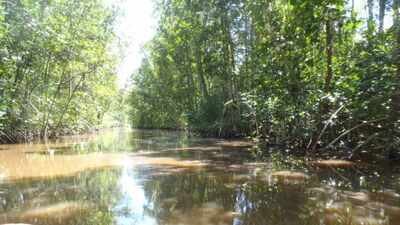
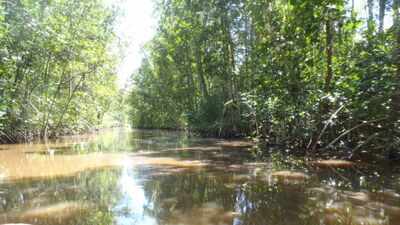
Guyana’s mangrove restoration programme planted more than 500,000 seedlings along 8 km of coastline, and a study published in Restoration Ecology has found that restored forests aged between 5 and 11 years were already supporting fish communities similar to those in natural mangroves. Researchers compared restored and naturally regenerated sites of the same ages along the Guyanese coast. The results showed no notable differences in fish abundance, species richness or community composition between the two habitat types, suggesting that fish had moved into restored mangroves relatively quickly.
Guyana’s journey from habitat loss to restoration of mangroves
The mangrove restoration work began against a backdrop of major habitat loss along Guyana’s coast. According to the study, the country’s mangrove belt had once been around 200 metres wide. Mangrove cover was estimated at 150,000 hectares in 1983, but had fallen to 81,000 hectares by 1992 and 22,000 hectares by 2011. Natural erosion, harvesting, excess siltation and coastal pollution contributed to the decline.The Government of Guyana responded by launching the Guyana Mangrove Restoration Project in 2010. The programme planted more than 500,000 Avicennia germinans seedlings, commonly known as black mangroves, across 19 locations covering 8 km of coastline. The restored sites examined in the study were generally planted as stands dominated by this single mangrove species.
How did researchers compare restored and natural mangrove forests
The researchers selected 10 locations for the study, including five restored and five natural mangrove forests. The sites were chosen to create comparisons between forests of the same age, covering 5, 6, 9, 10 and 11 years.The natural forests had developed after coastal erosion and mudflat stabilisation created conditions suitable for mangroves to return naturally. They contained black, white and red mangroves, while the restored areas were mainly planted black mangroves. The researchers also used satellite imagery to verify the ages of the natural mangrove areas.Fish were sampled during both the wet and dry seasons and during daytime and night-time. The team used nets placed inside the mangroves, counted the fish caught, measured their lengths and weights, and identified them as closely as possible to species level.
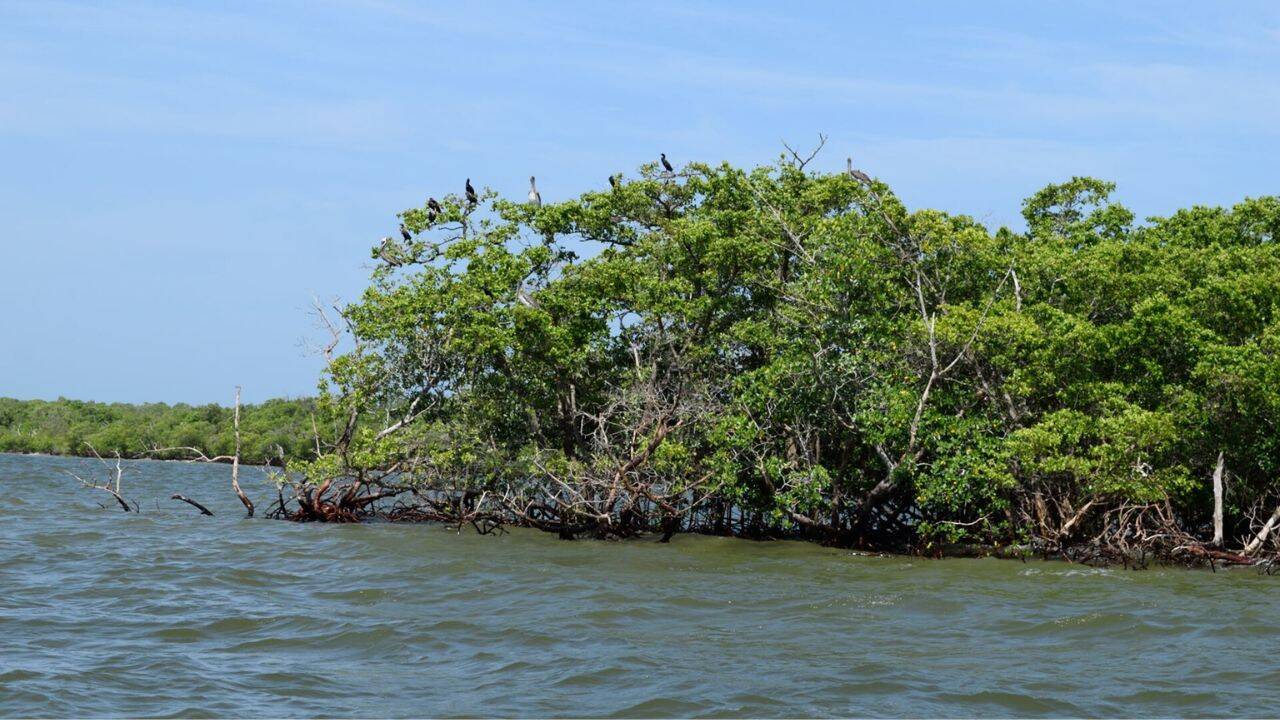
Pelicans and cormorants high in the mangrove trees. Image Credit: Wikipedia
What did the fish survey reveal
The survey recorded 559 fish belonging to 14 families and 18 species. The researchers found no significant difference in fish abundance between restored and natural mangroves. They also found no clear relationship between the age of a mangrove stand and the number of fish present.5 species accounted for about 94% of the total catch across all the habitats. Sciades couma was the most abundant, followed by Anableps anableps, Sciades herzbergii, Amphiarius rugispinis and Colomesus psittacus. The study found that Sciades couma was particularly widespread, occurring across the different mangrove stands examined.The restored sites contained approximately 90% of the fish species recorded in the natural mangroves. Statistical analysis also found no significant separation in fish community composition based on whether the habitat was restored or natural, its age, the season or the time of day.
Fish appeared to use restored habitat relatively quickly
One of the notable findings was that older restored mangroves did not consistently contain more fish than younger ones. In fact, some of the younger stands recorded the highest abundance and species richness.The 6-year-old restored habitat had the highest share of fish abundance among the restored sites, at 40%, while the 5-year-old and 11-year-old sites accounted for 26% and 19.5% respectively. There was no clear pattern showing fish numbers steadily increasing as the forests became older.This led the researchers to reject their original expectation that fish abundance and species richness would increase as the mangroves matured. Instead, the findings suggested that fish were able to colonise restored mangrove habitats early in their development.
The restored forests also developed substantial vegetation
The fish results came alongside similarities in the vegetation structure of restored and natural sites. Three mangrove species were recorded in the habitats namely Avicennia germinans, Laguncularia racemosa and Rhizophora mangle.Black mangrove was the dominant species overall, while 5-year-old restored sites were more strongly dominated by Laguncularia racemosa. The restored stands were denser overall, with 894 trees recorded compared with 446 in the natural stands. However, natural mangroves had a 52.1% higher density of Rhizophora mangle.Natural mangroves were also slightly taller on average, reaching 12.52 metres compared with 11 metres in restored areas. Their average trunk diameter was greater as well. Despite these structural differences, the study found no significant difference in the fish communities using the two habitat types.
What the findings mean for future restoration
The study provides evidence that planted mangroves can develop into useful fish habitat within a relatively short period.At the same time, the researchers stressed that the results do not mean the restored forests are identical to natural mangroves. Differences remained in vegetation structure, including tree density and the representation of individual mangrove species. The study also found that young forests can have less developed root systems and sparser canopies, so continued monitoring remains important as the habitats mature.