










Once upon a time, in 17th-century Nepal, a powerful kingdom was shaken by a decision that would haunt its history for centuries.A trusted man at the royal court fell from favour. A death followed. And, as the legends say, a woman on a funeral pyre uttered words that would eventually give an entire country a chilling name. Generations later, those words are still remembered.“Sati le Sarapeko Desh”- literally, the land cursed by Sati- is an expression that has found a place in Nepal’s cultural and historical memory. It has often been used to describe the country’s political troubles, instability and the sense that misfortune has repeatedly followed those in power. But where did this unusual expression come from?The answer lies in a centuries-old story of the Malla kingdom, royal intrigue and a man whose fate was sealed after accusations were levelled against him. At the centre of the tale is Kaji Bhim Malla, a powerful figure in the court of King Laxmi Narasimha Malla, and his wife, Bhuvanlaxmi. What happened to them, and why did their story become associated with the idea that Nepal itself was cursed?
The story behind ‘Sati le Sarapeko Desh ’
To understand the expression, we have to go back to the 17th century, when the Kathmandu Valley was ruled by the Malla kings.It was a period when royal courts were centres of power, ambition and intrigue. Among the influential figures of the time was Bhim Malla, who served under King Laxmi Narasimha Malla.According to traditional accounts, Bhim Malla was a capable military commander and administrator who also played an important role in Nepal’s trade and relations with Tibet. His growing influence brought him considerable standing at court. But prominence could also make a person vulnerable.Traditional accounts say that Bhim Malla’s success aroused jealousy among his rivals. Gradually, suspicion was created around him, and the king was allegedly led to believe that his trusted official posed a threat to his throne. The accusations would have devastating consequences.

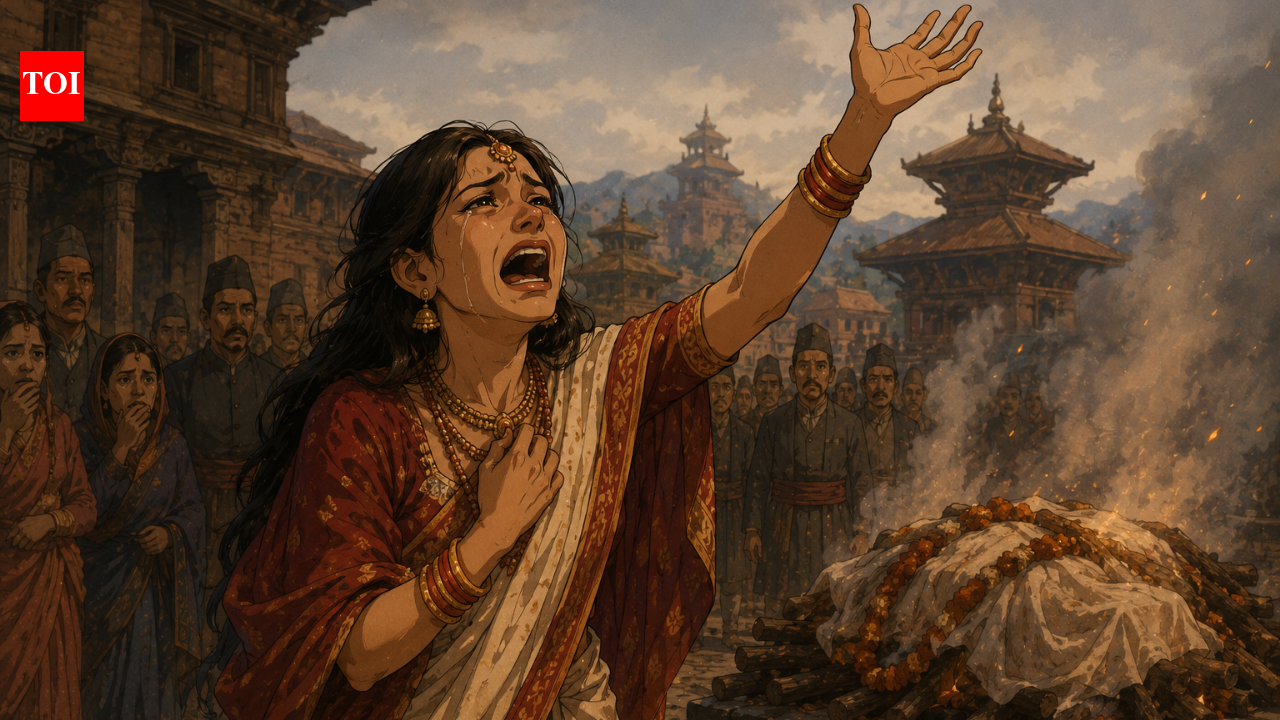
AI-generated image for representation
The fall of a powerful court official
Bhim Malla was eventually arrested and executed after being accused of conspiring against the king.The traditional narrative portrays his death as a grave injustice- the downfall of a man who had served the kingdom but was ultimately destroyed by suspicion and palace politics. Yet the most enduring part of the story concerns what happened after his death.His wife, Bhuvanlaxmi, was left to face the devastating consequences.At the time, the practice of sati existed in Nepal. A widow could be expected or compelled to die on her husband’s funeral pyre. According to legend, Bhuvanlaxmi went to the funeral pyre following her husband’s death. But before her own death, she is said to have cursed the kingdom over the injustice done to her husband: the kingdom and those who ruled it would suffer for what had been done. And from this tragic episode came the expression “Sati le Sarapeko Desh.”
What does the phrase actually mean?
The Nepali expression “Sati le Sarapeko Desh” translates roughly as “the country cursed by Sati.” Over time, however, it became more than a reference to Bhuvanlaxmi’s alleged curse.The expression began to be used as a metaphor for Nepal’s recurring political difficulties, instability and perceived failures of leadership. When people spoke of the country as “Sati le Sarapeko Desh”, they were not necessarily claiming that a supernatural curse was responsible for Nepal’s problems.Instead, the phrase carried a sense of irony and frustration- the belief that the country seemed repeatedly unable to escape its troubles. Nepal Database traces the expression to the story of Bhim Malla and his wife, whose tragic fate became embedded in Nepal’s folklore.
A legend, not a proven curse
There is no historical or scientific evidence that Bhuvanlaxmi’s words literally cursed Nepal or determined the country’s future.The story survives primarily as a traditional legend associated with a historical period and historical figures. Different accounts vary in their details, particularly around the exact circumstances and wording of the alleged curse.What makes the tale enduring, however, is not necessarily its supernatural element. It is the human tragedy underneath it. A powerful official allegedly lost his life because of palace intrigue. His wife, left powerless after his death, is remembered as having used her final moments to condemn the injustice she believed had destroyed her family.Centuries later, her alleged curse has become shorthand for a country’s struggles.And that is perhaps the most haunting part of “Sati le Sarapeko Desh”- whether or not one believes in the curse, the story continues to remind Nepal of what can happen when power, suspicion and injustice come together.