










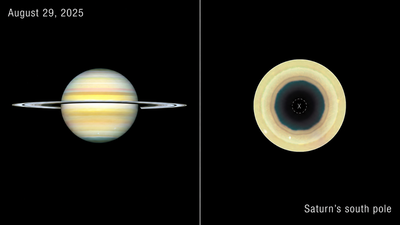
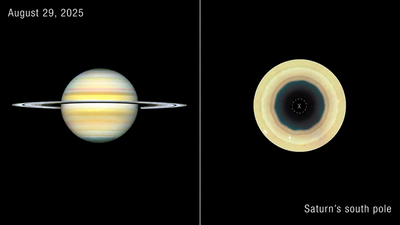
Saturn has revealed another strange feature in its atmosphere, and this time it is hiding around the planet’s south pole. New observations from NASA’s Hubble Space Telescope have captured a giant, evolving 10-sided atmospheric wave encircling the southern pole of the gas giant. The unusual formation, described as a decagon because of its 10-sided appearance, is embedded in one of Saturn’s powerful jet streams and extends through multiple layers of the planet’s atmosphere. What makes the discovery particularly interesting is that scientists have been able to trace subtle signs of the pattern back to 2023. Since then, the feature has become increasingly distinct, giving researchers an unusual opportunity to watch a large atmospheric pattern develop rather than simply observe one that has existed for decades. According to NASA, the discovery is the first time a large, regular-sided jet pattern has been observed in Saturn’s southern hemisphere.
NASA tracked the pattern
The feature is enormous, with a single side of the decagon already exceeding 10,000 miles (16,700 kilometres), according to the Associated Press. Researchers pieced together several years of Hubble observations dating back to 2023 to identify the developing structure. The observations were collected as part of Hubble’s Outer Planet Atmospheres Legacy, or OPAL, program, which has monitored the outer planets annually for more than a decade. The long-term observations allowed scientists to compare Saturn’s atmosphere over time and recognise changes that would be difficult to identify from a single image.The discovery became possible as Saturn’s changing seasons gradually brought its south pole back into view from Earth. Ground-based observations had already provided hints of the feature. In 2024, astronomers noticed a subtle undulating band around the southern pole, while additional images taken in 2025 offered stronger evidence of a developing decagonal pattern. Hubble’s position above Earth’s atmosphere then provided much sharper views of the planet, helping confirm the feature and trace it back to observations from 2023.
It is an atmospheric wave
The decagon is not a solid object or a permanent structure sitting on Saturn. Instead, it is a pattern created within the planet’s atmosphere. NASA says the wave sits inside one of Saturn’s powerful jet streams and extends through multiple atmospheric layers. This means the feature is more than a pattern visible only at the top of Saturn’s clouds. It is a vertically extended atmospheric structure. Its position also appears slightly different depending on the wavelength used to observe it. That is because different wavelengths allow Hubble to look at different altitudes within Saturn’s atmosphere. Together, those observations give scientists a more detailed picture of how the feature is arranged through the planet’s atmosphere.
Unlike the northern hexagon
The discovery is particularly intriguing because Saturn already has a famous geometric atmospheric feature at its north pole: the northern hexagon. That formation, first observed more than 40 years ago, has remained visible whenever astronomers have looked for it. The newly identified southern feature resembles the northern hexagon because both are associated with powerful polar jet streams and have striking geometric shapes. But NASA stresses that the two are also distinctly different. The southern decagon appears to be strengthening, rather than behaving like the long-established northern hexagon. This difference gives scientists a rare chance to observe the development of a major atmospheric pattern in real time.
A long-awaited counterpart
Scientists have actually been searching for a southern counterpart to Saturn’s northern hexagon for decades. According to NASA, researchers have examined Hubble observations of Saturn’s south pole since 1990 because the planet’s north-south jet-stream system is broadly symmetrical. Even NASA’s Cassini spacecraft, which orbited Saturn from 2004 to 2017, did not reveal evidence of a long-lived formation comparable to the northern hexagon. The newer Hubble data therefore provide an important clue: whatever is producing the southern decagon appears to have emerged relatively recently.
Why scientists are watching
The biggest mystery is not simply why the pattern has 10 sides, but why it appeared now. NASA researchers want to determine how the decagon formed, what drives it, and how long it will survive. Scientists will continue monitoring Saturn with Hubble, while observations from NASA’s James Webb Space Telescope and computer modelling could provide additional information. The years of OPAL observations are especially valuable because they allow scientists to study changing planetary atmospheres. Instead of relying on isolated snapshots, researchers can follow storms, seasonal changes and slowly evolving atmospheric structures.For Saturn, the southern decagon could therefore become a natural laboratory for understanding how enormous jet streams and atmospheric waves behave on gas-giant planets. Whether it eventually settles into a stable pattern like the northern hexagon or continues changing remains an open question. For now, Hubble has given astronomers something unusual: a front-row view of a giant atmospheric pattern taking shape around Saturn’s south pole.