










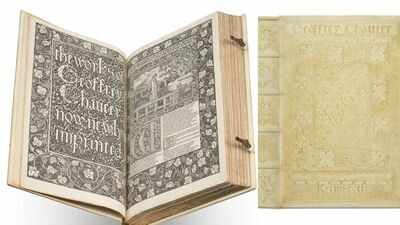
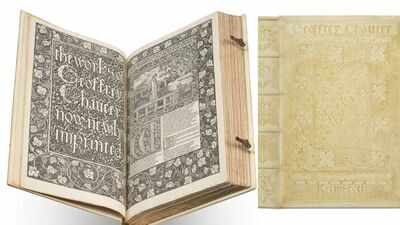
A book printed more than 130 years ago has drawn attention for its remarkable craftsmanship and rarity. ‘The Works of Geoffrey Chaucer’, an illustrated edition produced by British designer and printer William Morris in 1896, reportedly sold for Rs 2.68 crore in October 2026. Known as the Kelmscott Chaucer, the volume is celebrated for combining mediaeval literature with intricate printing, elaborate illustrations and an extraordinary binding.What makes this copy particularly special is that it retains its original white pigskin binding, designed by Morris, along with its original chemise and clamshell storage box made by the Doves Bindery. According to the Christie’s catalogue, approximately 50 copies of the book were commissioned in this deluxe binding, making it considerably rarer than the standard edition.
The 1896 masterpiece that took years to create
The Kelmscott Chaucer was one of the most ambitious projects undertaken by Morris at his Kelmscott Press in Hammersmith, London. Morris, known for his contributions to the Arts and Crafts movement, believed that books should be beautiful objects as well as vehicles for literature. The project brought together his printing and decorative designs with illustrations by his longtime artistic collaborator, Edward Burne-Jones. Work on the book began several years before publication, with printing starting in August 1894. The completed volume was issued to subscribers in June 1896.The edition contained 87 large woodcut illustrations based on Burne-Jones’s drawings. These were redrawn by Robert Catterson-Smith and engraved on wood by W. H. Hooper. Morris also designed the decorative borders, ornamental initials, title page and other elements that give the book its distinctive appearance. The book was printed in black and red using specially designed typefaces, including Chaucer type and Troy type. Its pages feature elaborate borders, decorative frames and large initial words, reflecting Morris’s attention to detail. The original edition comprised 438 copies, including 425 printed on paper and 13 on vellum, according to Christie’s catalogue.
Why the rare pigskin binding makes this copy special
Although the book itself is highly regarded, its binding adds another layer of historical and artistic significance. Morris designed a special white pigskin binding inspired by German bookbinding traditions of the 15th century. The covers feature intricate blind tooling, including grapevine patterns, roses, fleur-de-lys and oak-leaf motifs. The lower cover is divided into decorative geometric panels, while the spine has five compartments, and the book closes with two metal clasps.The design was influenced by historic bindings in Morris’s own library, including a 1478 Bible associated with the Salzburg binder Ulrich Schreier. The result combines mediaeval decorative influences with Morris’s distinctive approach to book design. The Doves Bindery executed the binding, and the catalogue identifies this particular copy as one of approximately 50 specially bound examples. The traditional count of these bindings has been 48, although bibliographical research suggests that additional copies were bound later.The book also comes with its original chemise and clamshell box. The leather-covered box was made over an oak structure, with a lined interior and a brass hinge and concealed clasp. Although the case has some wear and its locking mechanism is defective, retaining these original accessories adds to the copy’s historical interest.
A collector’s item valued for more than its age
The Kelmscott Chaucer has long been admired by book collectors, historians and design enthusiasts. Its importance lies not simply in its age but in the collaboration between Morris and Burne-Jones and the extraordinary care taken in its production. The University of Maryland Libraries describes the book as the culmination of Morris’s vision for an ideal book, while Trinity College Dublin highlights its place among the most ornate productions of the Kelmscott Press.The reported sale price of Rs 2.68 crore reflects the interest surrounding this exceptionally bound copy. However, the value of rare books can vary significantly depending on their condition, provenance, binding, completeness and the presence of original accessories. For collectors, this edition represents a meeting point between literature, printing history and decorative art. More than a century after its publication, the Kelmscott Chaucer continues to demonstrate how a printed book can become an enduring work of art.