









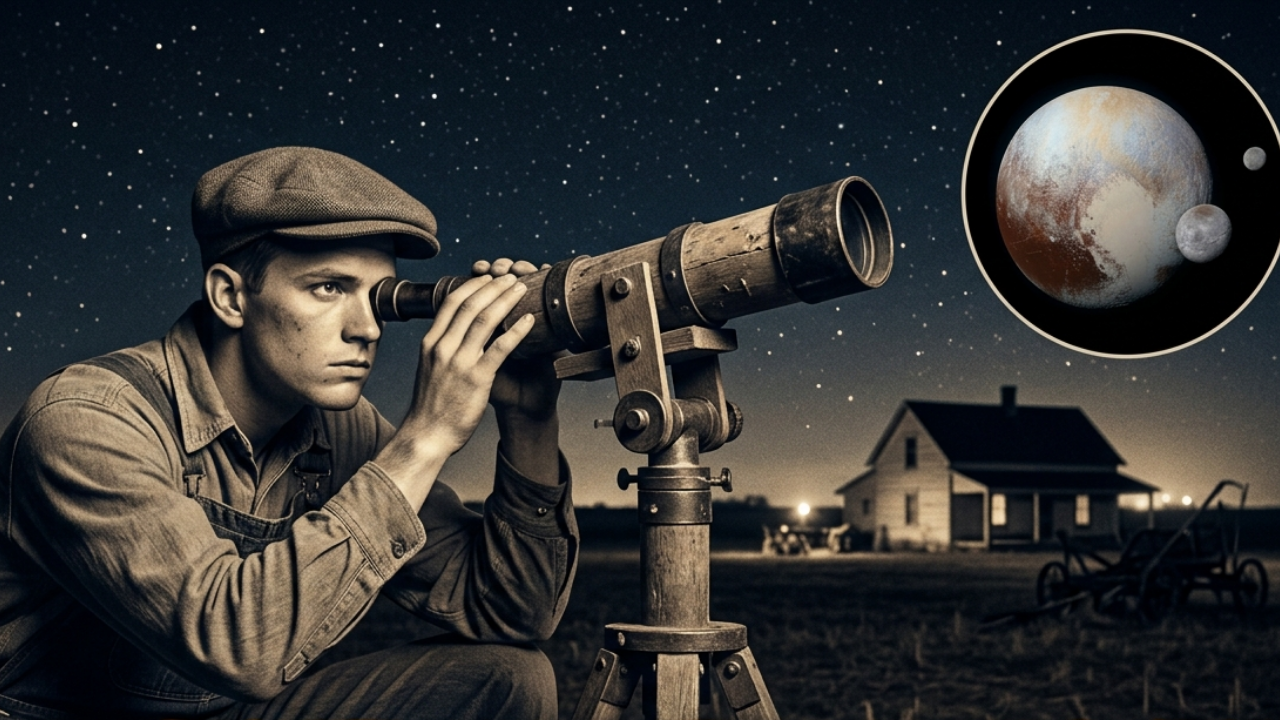
Long before Clyde Tombaugh was searching the skies from an observatory in Arizona, he was a farm boy trying to make sense of the night above his family’s home. The first telescope he owned was bought from Sears, but it soon failed to satisfy him. By 1925, he was building his own instruments, with help from his father, who took on extra work to pay for the materials. Tombaugh kept refining them, eventually producing a 23-centimetre reflector whose mount included parts from an old Buick and a discarded cream separator.His detailed drawings of Jupiter and Mars were good enough to attract the attention of astronomers at Lowell Observatory. Instead of receiving the advice he had asked for, Tombaugh was offered a job. He arrived with no college degree and joined a painstaking search for a suspected planet beyond Neptune. Ten months later, his photographs revealed another planet, Pluto.
A Kansas farm boy built his own telescope from old car and farm parts
Tombaugh’s interest in astronomy developed during his teenage years, at a time when owning a serious telescope was well beyond what his family could easily afford. He began constructing telescopes himself in a storm shelter on the family farm. The equipment was assembled from things that had already served other purposes. An axle from an old Buick, sections of metal tubing and gears from farm machinery all found their way into his experiments. Even an outdoor water faucet became part of one of the homemade instruments.The telescopes were crude compared with the equipment used at professional observatories, but they allowed Tombaugh to spend long hours examining the night sky. He concentrated on planets such as Mars and Jupiter and produced detailed drawings of what he saw.A hailstorm destroyed the family’s crops in 1928, leaving Tombaugh without the money he needed to attend college. His plans for formal study were put aside. Astronomy, however, continued.
A homemade telescope caught Lowell Observatory’s attention
Rather than abandoning the subject, Tombaugh decided to show his planetary drawings to someone who might understand the work he had been doing.He sent them to V.M. Slipher, the director of Lowell Observatory in Flagstaff, Arizona. Tombaugh was looking for an assessment of his homemade telescopes and observations. He was not expecting a job offer. Slipher was impressed enough to bring him to the observatory.According to APS Journals, Tombaugh arrived in Flagstaff in January 1929, when he was only 22. His initial assignment was connected to Lowell’s search for a proposed ninth planet, then referred to as Planet X. The observatory had been pursuing evidence of such an object for years.The young recruit was given the job of photographing sections of the sky. His photographs were recorded on glass plates, with repeated images taken on different nights. At first, analysing those plates was somebody else’s responsibility.Tombaugh learned to examine the photographs himself, searching for the tiny changes that could reveal an object moving through the distant background of stars. His duties at Lowell were not limited to astronomy, either. As a new member of the staff, he also had routine work to do around the observatory, including tending fires and clearing snow.
The slow hunt for a world beyond Neptune
The hunt for Planet X had a scientific reason behind it. Astronomers had been studying the movements of Uranus and had noticed irregularities in its orbit. Neptune, discovered in 1846, accounted for some of those effects, but questions remained about whether another distant body might be exerting an influence.For Tombaugh, the task was painstaking rather than spectacular. The sky was photographed repeatedly, section by section. A distant object would appear almost indistinguishable from the stars around it in a single image. Its movement became apparent only when photographs taken on separate nights were compared.The instrument that made the comparison easier was known as a blink comparator. It allowed Tombaugh to switch quickly between two photographic plates. Fixed stars appeared to remain in place, while an object that had shifted position could seem to jump from one location to another.
The tiny object Tombaugh spotted was the planet no one had confirmed
On February 18, 1930, Tombaugh was carrying out the same kind of work he had done many times before.Earlier that day, he had walked into town for breakfast at the Black Cat Cafe, a place he regularly visited. He returned to Lowell Observatory and continued working through the photographic material.Sometime around 4 pm, he saw something that appeared to move between two plates. The discovery was not immediately followed by a view through a telescope. His supervisor wanted the suspected object checked with Lowell’s larger instrument, but darkness was still some time away. When night came, clouds prevented the telescope from being used.Reportedly, Tombaugh went back to the Black Cat Cafe for dinner. Later, he went to the cinema and watched The Virginian, starring Gary Cooper. The following night, the weather finally allowed the larger telescope to be used.Tombaugh had found the body that Lowell Observatory had been searching for. It was eventually named Pluto.
Pluto stayed a planet for decades before its status changed in 2006
The announcement of the discovery was held back for several weeks while the observatory carried out further checks. It was finally made public on March 13, 1930. The date had its own connection to Lowell Observatory’s history. It was Percival Lowell’s birthday and also marked the anniversary of Uranus’s discovery.Pluto remained classified as the ninth planet for more than seven decades. That changed on August 24, 2006, when the International Astronomical Union adopted a new definition of a planet. Pluto no longer met the full criteria and was reclassified as a dwarf planet.The change did not alter what Tombaugh had actually observed in 1930. He had identified a previously unknown object moving against the background stars, and subsequent observations confirmed its place in the solar system.