










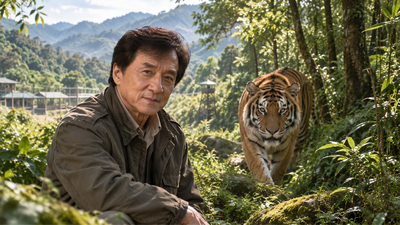
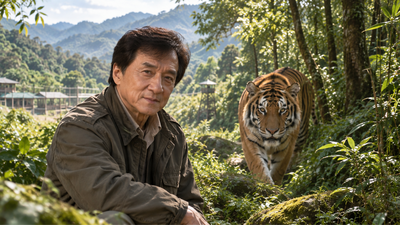
Jackie Chan supported Save China’s Tigers, a conservation project attempting to restore the South China tiger after the subspecies disappeared from confirmed wild sightings decades ago. Once widespread across southern and central China, the tiger (Panthera tigris amoyensis) suffered a dramatic decline because of hunting, habitat loss and falling prey numbers. Founded by conservationist Li Quan, the project adopted an unusual strategy by taking captive-born tigers to South Africa and giving them opportunities to develop hunting and survival skills in semi-wild conditions. Chan became an ambassador and helped raise awareness of the campaign. The eventual goal was to return suitable tigers to restored habitat in China. The effort has since evolved, with China developing new rewilding facilities while researchers study the animals’ genetics, prey and potential habitat.
Jackie Chan backed the campaign to save China’s lost tiger
Jackie Chan’s connection to the South China tiger came through Save China’s Tigers, founded by conservationist Li Quan. Chan served as an ambassador and helped bring wider public attention to the subspecies’ plight. In 2006, the organisation launched a Jackie Chan Tiger Face Awareness Campaign in Hong Kong, using his profile to promote tiger conservation and encourage public support. His involvement was primarily as a high-profile ambassador and campaign supporter rather than as the founder of the rewilding programme.The conservation group’s approach went beyond keeping the remaining animals in zoos and breeding them. It sought to prepare captive-born tigers for a possible return to nature by allowing them to develop hunting and survival skills in much larger, semi-wild environments. The programme was carried out in cooperation with Chinese wildlife authorities and eventually led to the transfer of South China tiger cubs to South Africa.
The South China tiger disappeared from the wild
The South China tiger once ranged across a large part of southern and central China. Hunting, persecution, habitat destruction and the depletion of prey caused its numbers to collapse during the 20th century. By the latter decades of the century, confirmed observations had become extremely rare. The IUCN SSC Cat Specialist Group now considers the South China tiger likely extinct in the wild, with the surviving population maintained in captivity.The exact date given for the last confirmed wild sighting differs between historical accounts, so conservation sources generally describe the subspecies as having gone unconfirmed in the wild for decades. Its disappearance created a difficult conservation problem. There was no established wild population left to protect or expand, leaving conservationists dependent on captive animals and the possibility of rebuilding the behavioural, genetic and ecological conditions needed for reintroduction.
Captive-born tigers were sent to South Africa
Save China’s Tigers began transferring captive-born South China tiger cubs from China to Laohu Valley Reserve in South Africa in 2003. The reserve offered large areas and abundant prey, allowing the animals to encounter live prey and develop hunting behaviours while remaining under conservation management. The tigers were not released freely into the African wilderness. Instead, they were kept in controlled environments designed to bridge the gap between zoo captivity and eventual life in the wild.Researchers later studied the hunting behaviour of these captive-born tigers and found that the animals could learn to hunt free-ranging prey. The programme also achieved reproduction in South Africa, including the birth of a South China tiger cub in 2007. These results demonstrated that captive-born animals could develop important behaviours associated with survival and reproduction in more natural conditions.The project nevertheless faced a much larger challenge. Teaching a tiger to hunt does not create a viable wild population. The animals would also need extensive suitable habitat, enough prey, protection from human pressures and a long-term management programme in China.
Scientists are tackling the genetic and habitat challenge
Genetics is one of the biggest issues facing the South China tiger. A genomic study published in BMC Biology found that the living animals examined could be traced to only two male and four female wild-caught founders. Researchers found that the captive population retained useful genetic variation but had also experienced severe population bottlenecks and inbreeding pressures.Maintaining genetic diversity is therefore central to any future reintroduction. A larger captive population does not automatically mean a genetically secure one, making careful breeding decisions important for preserving rare genetic variants and limiting further inbreeding.Researchers are also examining where the tigers could potentially live again. A 2024 habitat study identified around 83,415 sq km of core candidate habitat, including approximately 25,630 sq km overlapping existing protected areas. The researchers assessed habitat and prey availability under future climate scenarios and found that climate change could alter the suitability of areas for several prey species.
China is now preparing tigers for a possible return
China has begun expanding rewilding infrastructure within the South China tiger’s historical range. In June 2025, Fujian authorities announced a new rewilding training base at the Meihua Mountain South China Tiger Breeding Research Institute in Longyan. The facility covers about 1,500 mu, or 100 hectares, and includes adaptation, quarantine and training areas for captive tigers.Two tigers, Weiwei and Linlin, were moved into the facility in June 2025. The institute was reported to house 34 South China tigers and plans to use the larger environment to encourage behaviours needed for survival under increasingly natural conditions. The long-term objective is to prepare suitable animals for eventual release into appropriate habitat.The South China tiger remains likely extinct in the wild, but its conservation programme has moved from simply preserving captive animals towards preparing them for a possible return. Jackie Chan helped bring international attention to that effort, while rewilding experiments in South Africa demonstrated that captive-born tigers could develop hunting skills. Genetic research, habitat modelling and China’s expanding training facilities are now shaping the possibility of one day restoring the tiger to the forests where it once lived.