









Most professions reward certainty. A doctor is expected to diagnose, a lawyer to argue a clear position, a manager to make a firm call. Science runs on the opposite instinct. Neil deGrasse Tyson, the astrophysicist and director of the Hayden Planetarium, put it plainly in his book Space Chronicles: “You can’t be a scientist if you’re uncomfortable with ignorance, because scientists live at the boundary between what is known and unknown in the cosmos.” Not knowing something is not a failure state for a scientist. It is the actual working location, the spot where every real discovery eventually gets made. Tyson’s point cuts against how most people imagine expertise, as a steady accumulation of certainty, and replaces it with something closer to a permanent, comfortable relationship with not having the answer yet.
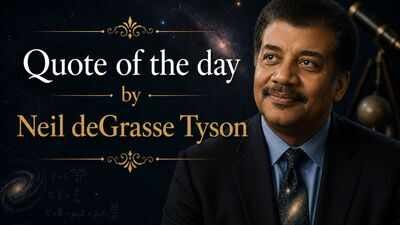
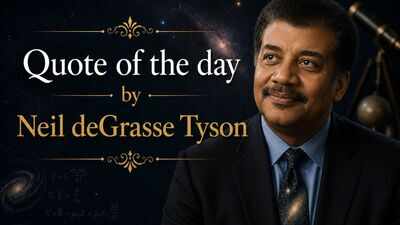
Quote of the day by Neil deGrasse Tyson
“You can’t be a scientist if you’re uncomfortable with ignorance”
What did Neil deGrasse Tyson mean by this quote
The quote draws a sharp line between two very different relationships with the unknown. Most people treat not knowing something as a temporary, uncomfortable gap to be closed as quickly as possible. Tyson is describing a different posture entirely, one where the unknown is not an inconvenience but the actual terrain a scientist works in every day.This reframes what expertise looks like at the highest level. A genuine expert, in Tyson’s framing, is not someone who has eliminated ignorance from their field. It is someone who has learned to work productively right at its edge, aware of exactly how much remains unresolved, rather than pretending the edge does not exist. Comfort with that unresolved space, rather than discomfort, is what lets the work continue.There is a useful test buried in this idea. Ask any genuine expert in a field what they still do not understand, and a confident, specific answer usually follows quickly. Ask someone with only surface familiarity the same question, and the answer tends to be vaguer, or an assumption that very little remains unknown at all. Comfort with ignorance, oddly enough, tends to increase alongside real expertise rather than decrease.Tyson’s own career gives this idea a public face. As a communicator of astrophysics to a general audience, he regularly has to explain not just what is known about the cosmos, but the far larger territory of what remains genuinely unresolved, from the nature of dark matter to the earliest moments after the Big Bang. That willingness to describe the edges of knowledge as clearly as the knowledge itself is a large part of why his explanations land as more trustworthy than a version that only ever claimed certainty.
Why journalists and scientists tell the story so differently
Tyson makes a specific, pointed observation elsewhere in the same passage that sharpens the quote considerably. He notes how often news coverage frames new discoveries as scientists being forced “back to the drawing board,” as though researchers had been sitting confidently with a finished answer before some inconvenient new finding knocked them off balance.His correction is simple. Scientists are always at the drawing board. There is no moment of false completion that a discovery then disrupts, because the boundary between known and unknown never actually closes in the way the phrase implies. The public, Tyson argues, tends to want a tidier story than that, jumping quickly from admitting total ignorance about something to demanding an absolute, final explanation, with very little patience for the long, uncertain middle where most scientific work actually happens.Tyson has elsewhere described this jump as a kind of argument from ignorance, where not understanding something gets treated as license to fill the gap with a confident claim rather than an honest admission that the answer is not yet known. A flashing light in the sky that nobody can immediately explain becomes, in this pattern, evidence of visiting aliens rather than simply an unresolved observation. The discomfort with an open question, in other words, does more damage than the open question itself.
The mindset separating curiosity from certainty
This same idea has deep roots in how science actually operates as a discipline, not just as Tyson’s personal observation. The philosopher Karl Popper argued in the twentieth century that scientific claims are only meaningful if they are falsifiable, meaning they must be open, in principle, to being proven wrong by future evidence. A theory that claimed to explain everything with no possibility of being disproved was not, in Popper’s view, doing science at all.That framework depends entirely on the comfort with ignorance Tyson is describing. A scientist who genuinely could not tolerate being wrong would have every incentive to protect a theory from testing rather than expose it to challenge. Progress in Popper’s model, and in Tyson’s description of how working scientists actually operate, requires treating your own current best answer as provisional, always available for revision the moment better evidence turns up.This is a considerably more demanding discipline than it sounds. It means genuinely wanting to know if you are wrong, not simply tolerating the possibility in theory while quietly hoping it never comes up. Popper’s falsifiability standard and Tyson’s boundary metaphor both describe the same uncomfortable requirement from slightly different angles: real understanding has to stay exposed to correction, or it stops being understanding and starts being belief dressed up in scientific language.
How to apply this quote by Neil deGrasse Tyson in daily life
You do not need a laboratory to use this idea. Most people, in careers and relationships alike, treat not having an answer as something to hide or rush past, presenting more confidence than they actually feel simply because uncertainty feels like weakness. Tyson’s framing suggests the opposite habit is more useful: naming what you do not yet know clearly, rather than papering over it with a guess dressed up as a conclusion.A practical version of this is noticing the moment you feel pressure to sound certain about something you have not actually worked out yet, in a meeting, a conversation, or a decision, and choosing instead to say plainly that you are still figuring it out. That admission costs less credibility than it feels like it will in the moment, and it usually leads to a better answer than a confident guess would have.This applies just as directly to how people handle their own mistakes and blind spots. Admitting you do not fully understand a situation, a person, or a problem, rather than filling the gap with a quick, confident-sounding explanation, is uncomfortable in the moment but tends to produce far better outcomes over time. The habit Tyson is describing for scientists, staying at the boundary rather than retreating from it, works just as well for anyone willing to sit with an open question a little longer than feels natural.
Other famous quotes by Neil deGrasse Tyson
- “People who believe they are ignorant of nothing have neither looked for, nor stumbled upon, the boundary between what is known and unknown in the universe.”
- “The good thing about science is that it’s true whether or not you believe in it.”
- “Ignorance is a virus. Once it starts spreading, it can only be cured by reason.”
- “I know of no time in human history where ignorance was better than knowledge.”