











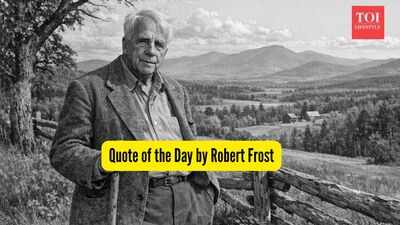
Robert Frost is one of the most famous poets of English literature. His poems beautifully celebrate the beauty, struggles, and quiet wisdom of everyday life. Frost became one of America’s most celebrated literary voices, with poems like The Road Not Taken, Stopping by Woods on a Snowy Evening, and Mending Wall. His work is often deceptively simple, using familiar images of forests, farms, snow and stone walls. But beneath the everyday images are deep insights into human relationships, choices, loneliness, nature and the intricacies of life. Frost’s words still ring true across generations, even decades after his death.Robert Lee Frost was born on March 26, 1874 in San Francisco, California. His father, William Prescott Frost Jr., was a journalist and teacher and his mother, the Scottish immigrant Isabelle Moodie, encouraged her son’s literary interests. In 1885 Frost’s childhood changed drastically with the death of his father from tuberculosis. The family moved across the country to Lawrence, Massachusetts where they lived with Frost’s grandparents. The move was financially difficult, but it exposed Frost to the New England countryside that would become the defining landscape of his poetry. Frost was an early lover of reading and writing as a student. He was co-valedictorian with Elinor White, his future wife and one of the greatest influences in his life.The difficult road to successUnlike many famous writers who were recognised early on, Frost’s journey to literary success came much later. He briefly attended Dartmouth College before dropping out. He later enrolled at Harvard University, but had to leave due to health problems and financial difficulties. He was a teacher, newspaper reporter, factory worker and, perhaps most famously, a farmer over the years.But farming was never much of a money-maker. Frost was poor, but those years provided him with first-hand experience of rural life. The rhythms of agriculture, the changing seasons, the close relationship between humans and nature became recurring themes in his poetry. Frost and his family moved to England in 1912 after being rejected by American publishers for many years. It was a life-changing decision. In two years he published his first two collections of poems, A Boy’s Will (1913) and North of Boston (1914). His work was well received in British literary circles, and when Frost returned to the United States in 1915, he was already a popular poet.Robert Frost’s style of writingOne reason Frost remains so popular is that his poems are accessible but not simplistic. Many of his poems seem, on the surface, to be descriptions of commonplace rural scenes: walking through snowy woods, mending a stone wall with a neighbour, deciding between two forest paths, or stopping by an apple orchard. And yet these mundane moments are often metaphors for much larger questions about life.His style of writing is characterised by several features:Plain language: Frost didn’t use unnecessarily complex vocabulary. His poems are accessible but not easy to read. They give the reader new meanings each time they are read again. Nature as Symbolism Trees, snow, fields, birds and changing seasons are never just scenery. They are often emotional states, moral dilemmas or philosophical ideas. Frost believed poetry should sound like everyday speech. Many of his poems read more like conversations than literature. Traditional Forms: While many poets in the twentieth century experimented with free verse, Frost tended to stick with traditional rhyme and metre. He famously said writing free verse was “like playing tennis without a net.” Hidden complexity: One of Frost’s greatest gifts was his ability to hide deep psychological and philosophical questions in deceptively simple narratives.His services to literatureRobert Frost revolutionised American poetry by showing that universal truths could be expressed through ordinary rural experiences. His work helped define American literature in the twentieth century and is still among the most widely taught poetry in schools and universities throughout the world. His greatest accomplishments are:
- No other poet has won the Pulitzer Prize for Poetry as many times as he has — four times.
- He emerged as one of America’s most famous public intellectuals.
- He recited his poetry at the inauguration of U.S. President John F. Kennedy in 1961, becoming the first poet to participate in a presidential inauguration.
- His poetry continues to influence writers, teachers and readers around the world.
Frost was not concerned with poets who wrote of great events in history. Instead, significance was found in the decisions and relationships of daily life. His writing reminds us that the biggest questions in life are often the result of the most mundane moments.What the quote means “A mother spends twenty years making a man out of her boy, and another woman makes a fool of him in twenty minutes.”Quote of the Day“A mother takes twenty years to make a man of her boy, and another woman makes a fool of him in twenty minutes,” is replete with sarcasm. This is one of Frost’s most widely circulated sayings, though its tone is different from much of his published poetry. And it has survived because it is a combination of humour and irony and an observation on family dynamics. At first reading, the statement seems to set up a contrast between two relationships. A mother spends years raising, teaching and guiding her son into adulthood. Then, in the joke, romantic love comes along and rapidly alters his behaviour. The line draws on a long tradition in literature of exaggerating the dramatic effect of romantic relationships. It describes how people can sometimes act irrationally in love, making impulsive decisions, ignoring good advice or acting in ways that surprise family and friends.The quote should not be taken literally, nor as a serious statement about women. Instead, it depends on hyperbole, or deliberate exaggeration for humorous effect. There have been similar jokes in many cultures , often mocking men and women alike for the irrational things they do in the name of love. But to the modern reader the quote can appear dated. It reflects traditional gender stereotypes where mothers are wise caretakers and romantic partners are held accountable for men’s bad decisions. Modern readers might challenge that assumption, seeing healthy relationships as strengthening rather than weakening personal growth.Perhaps the quote’s endurance is not in its literal sense but in its acknowledgement of a universal truth: love’s phenomenal power to change human behaviour. We’ve all seen someone fall in love and change for the better or worse. More than sixty years after his death in 1963, Robert Frost remains one of the world’s most beloved poets, because he understood something timeless about human nature. He understood that life’s profoundest lessons are frequently imparted by the plainest experiences – a walk in the woods, a conversation with a neighbour, an evening of snow or a difficult choice.His poetry prompts readers to pause, look closely and find meaning in the everyday. Individual quotations like this may be controversial, but they also point to Frost’s ability to provoke thought in plain language. Whether it’s relationships or the choices that define our lives, in the work of Robert Frost we find inspiration to look below the surface, where the deepest truths often lie hidden.