










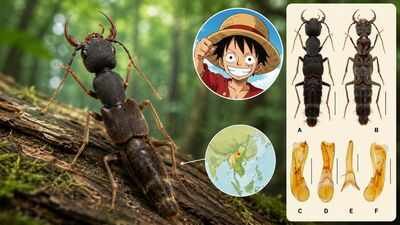
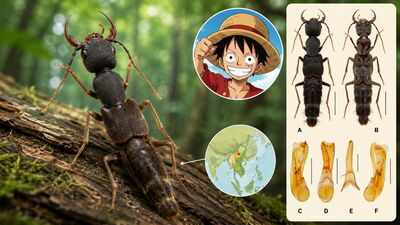
A scientific paper describing a previously unknown group of rove beetles has produced an unusual meeting point between taxonomy and popular culture. Researchers have introduced a new beetle genus named Luffy, borrowing the name of Monkey D. Luffy, the central character from the long-running manga and anime series One Piece. While the choice may appear playful at first glance, it reflects a specific anatomical feature rather than simple fandom.According to the study published in Zookeys, titled “Luffy gen. nov., a new genus of Staphylinina (Coleoptera, Staphylinidae, Staphylininae), remarkable for understanding the Eucibdelus lineage”, the beetles possess remarkably elongated mouthparts, antennae and palps that reminded the researchers of the fictional pirate’s stretchable body. The naming also serves as a way of making biodiversity research more approachable without compromising scientific standards.
How scientists identified the new Luffy beetle genus
The research was led by Fang-Shuo Hu and Alexey Solodovnikov from the Natural History Museum of Denmark. The team described an entirely new genus within the rove beetle subtribe Staphylinina, introducing two newly identified species: Luffy schillhammeri, discovered in Yunnan Province in south-west China, and Luffy nika, collected in northern Laos. The paper places the genus within the Ocypus-group and proposes that it represents the closest known sister lineage to the Eucibdelus group, offering a missing evolutionary link in this branch of rove beetles.According to the BBC, the discovery followed detailed comparisons of numerous museum specimens and living collections, allowing the researchers to separate these beetles from every previously recognised genus. Rather than relying on a single feature, they evaluated subtle differences across several body structures before concluding they represented an entirely distinct lineage.
Why the new beetle genus was named after One Piece character Luffy
Scientific names often commemorate researchers, locations or distinctive characteristics. In this case, the genus name reflects the beetles’ unusually long and slender anatomy.According to the study, the new insects have elongated antennae, maxillary palps and mandibles unlike those of closely related genera. Those proportions inspired the reference to Monkey D. Luffy, whose fictional abilities allow his limbs and body to stretch like rubber after consuming the Gum-Gum Fruit. The authors explicitly state that the generic name refers to these extended body parts rather than the character’s personality or story.The individual species names have different origins. Luffy schillhammeri honours Austrian beetle specialist Harald Schillhammer for his long-standing contributions to the taxonomy of rove beetles, while Luffy nika references Luffy’s “Nika” form from the manga, inspired by the pale hairs visible on the newly described species.
Why the new Luffy beetle genus is important for beetle evolution
Although the anime reference attracted attention, the researchers stress that the discovery has wider taxonomic importance. Rove beetles represent one of the largest groups of insects on Earth, yet relationships between several of their evolutionary branches remain unresolved.According to the study, the new genus combines characteristics previously seen separately in different groups. It possesses certain mandibular features associated with the Eucibdelus lineage while retaining a partially membranous labrum found in other members of the Ocypus-group. That combination suggests Luffy occupies an intermediate evolutionary position rather than fitting neatly into existing classifications. The authors argue that its anatomy helps clarify how these lineages are related and offers fresh evidence for revising the evolutionary history of this beetle group.Several distinctive traits unique to the new genus, including exceptionally long antennae and unusually narrow front feet, hint that these insects may occupy a specialised ecological niche that remains unknown. Their behaviour and preferred habitats still require further investigation.
How the new Luffy beetle highlights Earth’s hidden insect diversity
Reportedly, beetles account for roughly 400,000 formally described species, making them one of the most diverse groups of animals. Scientists estimate that hundreds of thousands, and possibly well over a million, species have yet to be identified.Against that backdrop, the discovery of Luffy illustrates how even extensively studied insect groups continue to reveal unexpected diversity. The researchers hope that linking a scientific name to a globally recognised fictional character will draw more public interest towards taxonomy, a field that underpins biodiversity research by identifying and classifying life on Earth.Rather than being a novelty, the name represents a carefully considered scientific choice rooted in morphology. It also reflects an increasingly visible trend in modern taxonomy, where cultural references are occasionally used to make discoveries more memorable while remaining consistent with the formal rules of biological naming.