










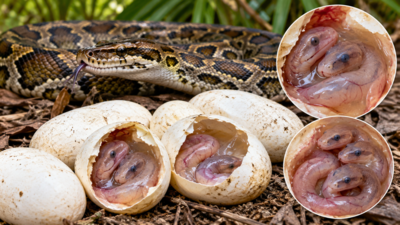
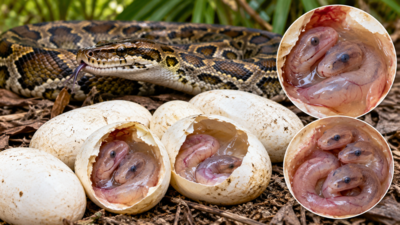
Scientists have discovered twin and triplet embryos inside two eggs laid by a single wild Burmese python in southern Florida, marking the first recorded instance of triplet embryos in a snake. The unusual finding emerged from a clutch of 37 eggs laid on 17 May 2024 by a radio-tagged female python in Big Cypress National Preserve. While 32 eggs hatched normally, researchers found two non-viable eggs containing five embryos in total, all of which had died before hatching. According to the study published in Ecology and Evolution titled ‘First Record of Twin and Triplet Embryos Found in the Clutch of a Wild Burmese Python in Southern Florida ’, the discovery raises questions about how multiple embryos develop within a single snake egg and how often such occurrences happen in the wild.
What did scientists discover inside the Burmese python eggs
The unusual clutch was laid on 17 May 2024 by a female Burmese python measuring 313.7 centimetres in snout-to-vent length. The eggs were deposited within a hardwood hammock in Big Cypress National Preserve, where researchers were already monitoring python reproduction and survival as part of a long-term study. The clutch was monitored in its natural location, allowing scientists to observe the development and eventual hatching of the eggs.On 14 July 2024, researchers removed the female from the clutch before the expected hatching period to install an enclosure designed to prevent hatchlings from escaping. The enclosure consisted of a polyvinyl chloride frame covered with two nested mesh laundry bags. Non-viable eggs were removed during the process, while trail cameras were used to monitor the remaining eggs remotely. Hatching began on 17 July, and researchers collected, weighed and measured the emerging hatchlings over five days; the process completed on 22 July 2024.
PC: First Record of Twin and Triplet Embryos Found in the Clutch of a Wild Burmese Python in Southern Florida
How were the twin embryos inside Egg A different in their development
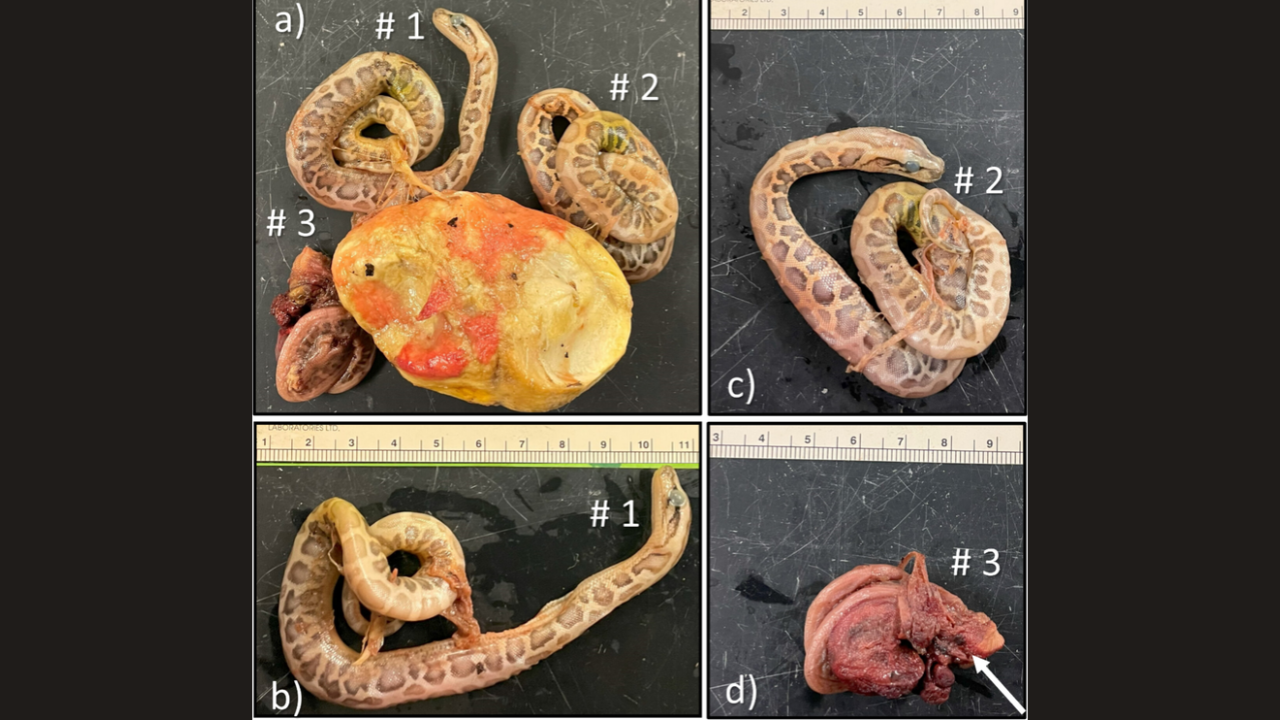
The first unusual egg, identified as Egg A, contained two female embryos. When researchers examined it on 22 July, they found a two-centimetre slit in its shell, indicating that the hatching process, known as pipping, had begun. Both embryos were attached to the same yolk and had died. Their development, however, was not identical. One embryo had developed more extensive pigmentation but showed significant skeletal and developmental abnormalities, while the other had a more normally developed body and intact organs.The second egg, identified as Egg B, contained three embryos at different developmental stages. Unlike Egg A, this egg remained intact, with no signs that hatching had begun. Two of the embryos were similar in size and weight, while the third was considerably smaller and less developed. The researchers recorded that the smallest embryo weighed just 5.6 grams and had a compressed body, particularly around the head and neck. The sexes of all three embryos could not be determined. All were connected to the same yolk, much of which remained unabsorbed.
What is monozygotic twinning, and how does it occur in reptiles
The study also examined how multiple embryos might develop inside a single reptile egg. Researchers explained that twinning can occur when one fertilised egg divides into two independent embryos, a process known as monozygotic twinning. Another possibility is dizygotic twinning, in which two separately fertilised eggs, each with its own yolk sac, become enclosed within the same eggshell. Scientists have previously proposed that differences in embryo size and egg dimensions could help distinguish between these processes.In the Burmese python clutch, however, both unusual eggs were similar in size to the other eggs, and all embryos were connected to a single yolk. The two embryos in Egg A also had similar body masses, observations that suggested a possible monozygotic origin. However, the researchers cautioned that physical characteristics alone could not establish how the embryos originated. They noted that yolk sacs may fuse to form a common yolk sac, meaning further genetic testing would be necessary to determine the embryos’ origins conclusively.
Why are twin and triplet embryos so rare in wild Burmese pythons
The researchers noted that multiple-embryo eggs are reported in other reptiles, including lizards, turtles and crocodiles, but documented cases in snakes have been considerably more limited. Earlier reports of snake twins had largely involved captive-bred individuals or wild-caught females that laid eggs in captivity. The first documented Burmese python twins came from a captive-bred clutch in which two eggs each contained a pair of embryos. Neither pair survived to hatch. Before the southern Florida discovery, the scientific literature had not documented triplet embryos in snakes.The researchers also highlighted that the frequency of such eggs in wild Burmese pythons remains unknown. Previous observations of wild python clutches in southern Florida had not identified similar cases. The female involved in the study had also laid a clutch in May 2022 of 19 viable eggs and one non-viable egg, none of which contained multiple embryos. The authors described the occurrence as uncommon based on their observations and stressed that further research is needed to establish how frequently it happens, whether such embryos can survive to hatching and how these unusual reproductive events affect the species’ overall reproductive output. Although none of the five embryos in the 2024 clutch survived, the discovery provides a documented example of both twin and triplet development in eggs laid by a wild snake.