










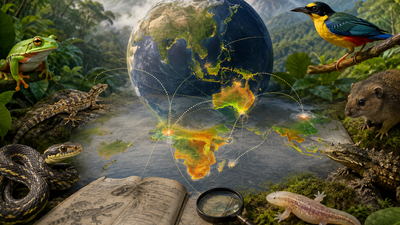
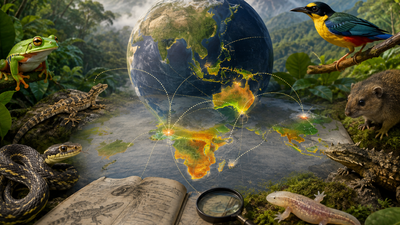
For much of the past century, scientists have steadily expanded the catalogue of life on Earth, adding species that were previously unknown to science and refining the ranges of those already documented. But what happens when those discoveries are added back into the maps scientists use to understand global biodiversity? A new study published in Ecology Letters examined how a century of taxonomic discoveries changed estimates of where terrestrial vertebrate diversity is concentrated. The results show that global diversity patterns remained relatively stable for some groups but changed substantially for others, particularly reptiles and amphibians.
Looking back a century
The researchers examined terrestrial vertebrate discoveries between 1920 and 2020 to determine how accumulating taxonomic knowledge altered estimates of global diversity patterns. Rather than simply counting the number of species known at different points in time, the study investigated how the locations considered important biodiversity centres changed as new species were formally recognised. The researchers also examined whether the environmental factors associated with species diversity changed alongside those discoveries.This approach is important because biodiversity maps are built from the species scientists know about. If large numbers of species in particular regions remain undescribed, the apparent distribution of biodiversity can be incomplete.
Reptiles show major shifts
The most striking changes appeared among reptiles and amphibians. According to the study, estimated diversity patterns remained relatively stable for birds, while environmental drivers of species richness remained stable for birds and mammals. Reptiles and amphibians, however, underwent notable reconfiguration as taxonomic knowledge accumulated.The researchers found that 20.3% of reptile diversity centres and 31.7% of amphibian diversity centres shifted to different regions between 1920 and 2020. These figures refer to the diversity centres identified by the researchers, rather than the proportion of all reptile or amphibian species that changed location. In the study, a diversity centre refers to an area falling within the top 5% for total range-weighted rarity. This measure allows scientists to identify places containing species with particularly restricted distributions, rather than simply looking at where the greatest number of species occur. The findings therefore suggest that discovering and formally recognising species can change which parts of the world appear most important for biodiversity conservation.
Australia and Southeast Asia emerge
Australia and Southeast Asia were among the regions that became more prominent after newly documented species were incorporated into the analysis. The shift was particularly notable for reptiles and amphibians, groups for which global biodiversity estimates can be less reliable because taxonomic knowledge remains incomplete. As scientists identify additional species and refine their distributions, regions that previously appeared less significant can emerge as important centres of biological rarity.The study’s supporting analyses also show that diversity centres can be classified as emergent, historical or stable. Emergent centres are areas that became diversity centres after new species discoveries, while historical centres were initially identified as important but subsequently diminished in relative importance. Stable centres remained important across the comparison.
Climate picture also changes
The discoveries did more than alter the geographical map of biodiversity. They also changed scientists’ understanding of the environmental factors associated with species diversity. The researchers found that the apparent influence of temperature declined, while precipitation became more important for reptiles and amphibians, groups whose body temperatures are strongly influenced by their surroundings.This means that conclusions drawn from incomplete species inventories can potentially give researchers a different impression of why certain regions contain more species than others. As additional species are discovered, those relationships can be reassessed using a more complete picture of biodiversity.
Knowledge gaps remain
The researchers’ findings point to a broader problem in biodiversity science: the global inventory of life is still incomplete. Species discovery does not necessarily mean scientists have found an entirely unknown animal in an unexplored wilderness. New species can emerge from continued fieldwork, closer examination of populations previously considered a single species, improved taxonomic research, and a better understanding of species distributions. The study therefore treats taxonomic work as an important part of understanding biodiversity rather than simply a process of assigning names to organisms.
Why discoveries matter
Knowing where species diversity is concentrated is fundamental to conservation planning. If the locations identified as biodiversity centres change as new species are documented, conservation priorities may also need to be reassessed. The study suggests that this issue is especially important for groups whose diversity remains comparatively less well known. According to the researchers, the estimated global diversity patterns and their environmental drivers may be less reliable for poorly known groups than is often assumed.After a century of accumulating knowledge, the global biodiversity map is therefore still being redrawn. The research shows that discovering and formally recognising species is not simply about adding new names to a list. Each addition to taxonomic knowledge can alter scientists’ understanding of where Earth’s biological rarity is concentrated and highlight regions that may deserve greater conservation attention.