










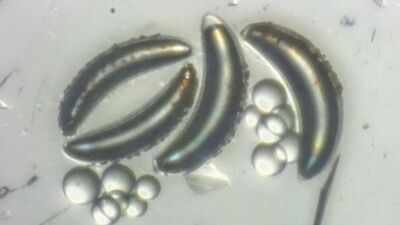
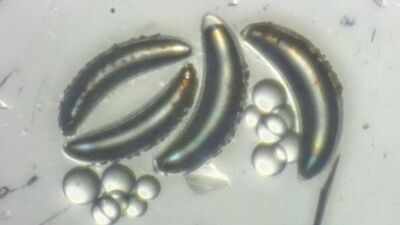
For years, scientists have believed one major reason insects are almost absent from the ocean is simple physics: their air-filled bodies would collapse under deep-water pressure. But a tiny insect larva living in Africa’s Lake Malawi is challenging that idea in a surprising way.Every day, billions of lake fly larvae, called Chaoborus edulis, perform a remarkable vertical commute. By day, they sink more than 200 meters into the lake’s oxygen-poor “dead zone” to hide from predators. By night, they rise closer to the surface to feed, though that journey comes with its own danger, because fish are waiting along the way.
CJP Jantar Mantar Protest Updates
A hidden survival trick
Researchers from the University of British Columbia, Dr.Philip Matthews and Dr. Evan McKenzie, used a sonar system placed at the bottom of the lake to track the larvae’s movements, as per a report on Phys.org. But what they found was more than a trick of survival; a clever biological adaptation that might explain how these insects can survive such extreme conditions.When the team dissected the larvae, they found that part of their respiratory system had been converted into two pairs of tiny air sacs.The sacs act as ballast tanks, allowing the larvae to control their buoyancy in the water. This means the larvae are not just passively floating along . They are actively changing their position in the lake by changing their internal air levels, like a little underwater craft .Their work was published recently in the journal Science.
A pH-powered mechanism
The researchers also found something even more fascinating: the walls of these air sacs contain resilin, a highly elastic material already known in other insects for its strength and flexibility.In this case, the resilin seems to respond to changes in pH, expanding or contracting as the larvae adjust the acidity of the sac walls.This pH-driven response allows the larvae to change the volume of the sacs, which in turn changes their buoyancy. In simple terms, the larvae appear to use chemistry to control depth.It is an elegant system. Instead of muscles, the larvae rely on an internal material that behaves as a natural smart material, reacting to their environment so they can swim through water with precision.
Pushing their limits
To find out how much pressure these larvae could withstand, the scientists placed them in tiny pressure chambers. Then they slowly raised the equivalent depth. The results were nothing short of amazing. The larvae survived conditions equivalent to more than 400 meters below the surface, much deeper than their normal daily dives. That finding is important because it shows their air sacs are far tougher than scientists expected.It also weakens one long-standing explanation for why oceans have so few insects. If insect air sacs can survive pressures far beyond their usual range in deep lake water, then the idea that insect respiration alone prevents ocean colonization may not be the full story.
Why this matters
Insects are everywhere on land and in fresh water, but the open ocean remains almost completely insect-free.This discovery does not erase that mystery, but it does complicate it.The study suggests that some insects may be physically more capable of surviving underwater pressure than previously assumed.That opens the door to new questions about evolution, habitat limits, and the biological barriers that keep insects out of marine environments.It also shows how much nature still has to teach us. A creature as small and easily overlooked as a lake fly larva may hold clues to one of biology’s enduring puzzles.
Beyond biology
The researchers believe the findings could have practical uses too. Because resilin can expand and contract in response to pH changes, it may inspire future work on smart materials, artificial muscles, and other chemical-response systems.That makes this discovery relevant beyond ecology. It could inform engineering and material science by showing how a natural system uses pressure, elasticity, and chemistry together in a highly efficient way.In the end, these larvae are doing more than surviving a harsh environment. They are rewriting what scientists thought was possible for insects in deep water.