









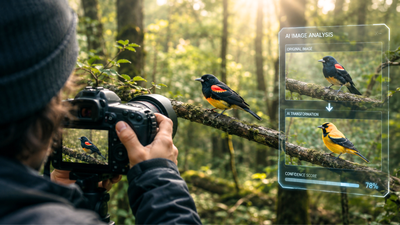
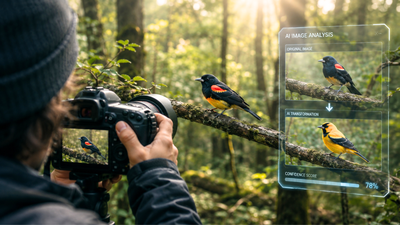
Artificial intelligence has transformed wildlife photography, allowing people to sharpen blurry images, remove distracting branches and enhance colours with just a few clicks. But scientists now say these seemingly harmless edits could have unintended consequences far beyond social media. A new commentary published in Nature Ecology & Evolution warns that AI-enhanced bird photographs are beginning to contaminate citizen-science databases that researchers use to monitor biodiversity, migration patterns and the effects of climate change. As millions of birdwatchers upload observations every year, even subtle AI-generated alterations could create false species records, making it harder for scientists to distinguish genuine sightings from digitally manipulated ones.
Why are scientists concerned about AI-edited bird photos ?
Researchers say the biggest threat is not entirely fake bird images but real photographs that have been enhanced using generative AI tools. Features such as feathers, wing patterns or colours can be unintentionally altered when users ask AI to remove branches, improve lighting or sharpen an image. These small changes may make a bird appear to belong to a different species, creating inaccurate records in scientific databases.The warning comes from a commentary published in Nature Ecology & Evolution by researchers from organisations including Manchester Metropolitan University, Cornell Lab of Ornithology, iNaturalist and the Macaulay Library.
How can AI create fake bird sightings?
One example highlighted by the researchers involved what appeared to be the first sighting of a red-winged blackbird in central Brazil, where the species had never previously been recorded. The image was later found to be an AI-enhanced photograph of an epaulet oriole after the photographer used an AI tool to make the picture “look better.”Scientists say this case was not a deliberate hoax. Instead, the AI software introduced identifying features from another species, demonstrating how simple edits can accidentally produce false scientific records.
Why do citizen-science platforms matter?
Platforms such as iNaturalist and the Macaulay Library are widely used by researchers studying wildlife around the world. Millions of observations submitted by volunteers help scientists monitor species distributions, migration routes, breeding behaviour and the effects of climate change.These databases have contributed to numerous scientific discoveries because they provide observations from locations and times that professional researchers cannot always reach. Maintaining accurate records is therefore essential for conservation and ecological research.
How widespread is the problem?
The researchers say the true scale of AI-related image manipulation remains unknown. iNaturalist hosts more than 610 million images, but only about 1,400 have so far been flagged for AI-related issues. Experts believe many more altered images may go undetected because subtle edits can be difficult to identify.While obvious fake sightings, such as a tropical bird appearing in an impossible location, are usually easy to dismiss, minor AI enhancements are far more difficult to detect and may quietly affect biodiversity records.
What can be done to protect scientific data?
Scientists are urging citizen-science platforms to strengthen safeguards against AI-generated content by improving moderation, developing better detection tools and encouraging users to disclose when AI editing has been used. They also recommend educating photographers about the risks of altering biological features, even unintentionally.Researchers emphasise that AI itself is not the problem. The technology already plays an important role in species identification and conservation research. The concern is ensuring that photographs submitted as evidence of wildlife observations accurately represent what was seen in nature, preserving the reliability of the scientific data that conservation efforts depend upon.