










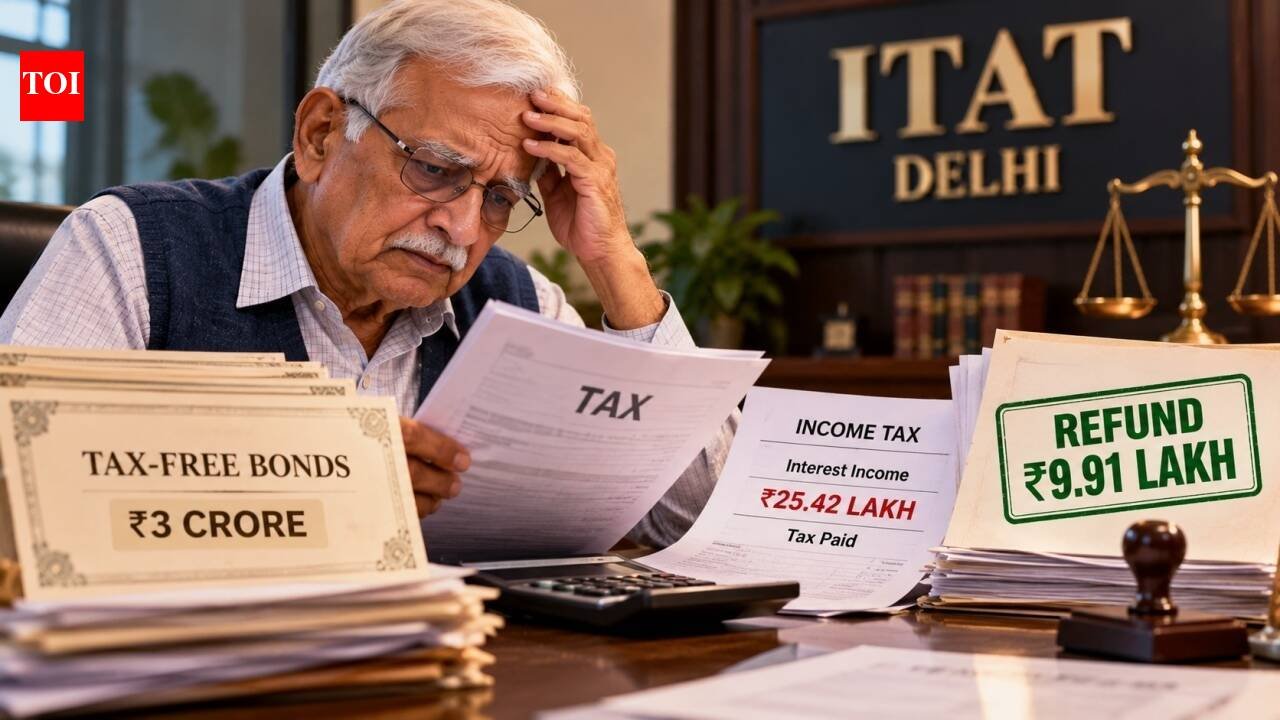
What if you end up paying taxes on a tax-free income? Will you be refunded? In one such case a senior citizen man erroneously ended up paying tax on his interest earnings. A senior citizen living in Gurugram invested Rs 3 crore in two government tax-free bonds in 2013.Here’s what the Income Tax Appellate Tribunal (ITAT) Delhi ruled.
What the case is about
Each year, the senior citizen reported the interest earned from his investments in tax-free bonds under the ‘exempt income’ category in his income tax return (ITR). However, while filing his return for AY 2022-23, he mistakenly treated Rs 25.42 lakh in interest from the bonds as taxable income from other sources.This included Rs 16.96 lakh that he earned from IFCL bonds and he got Rs 8.46 lakh from REC bonds. As a result, he ended up paying Rs 9.91 lakh in income tax. He was, however, not required to pay this amount since the investments by their definition were tax-free.However, the man realised the error only after the deadline for filing a revised ITR had passed. He therefore approached the jurisdictional assessing officer (JAO) and filed a rectification application under Section 154 on January 19, 2024.But, the JAO rejected this request from the senior citizen. The JAO took the view that a claim for such a deduction could not be considered by the JAO except through a revised ITR. The officer relied on the Supreme Court’s decision in Goetze (India) Ltd. v. CIT.The Commissioner of Appeals (CIT A) upheld this decision.The senior citizen then challenged the matter before the Income Tax Appellate Tribunal (ITAT) Delhi.
Why did the senior citizen win the case?
The ITAT Delhi observed that the rectification requested by the senior citizen was aimed at correcting an error apparent from the existing record and did not amount to making a new claim.The tribunal held that the ruling in Goetze (India) Ltd., which the AO had relied on while turning down Bakaya’s rectification application, did not apply to the present case.The ITAT referred to the coordinate Bench’s decision in the case of Kapil Dev Nikhanj, where it was held that the Goetze India decision referred to (supra) only limits the assessing authority from entertaining a fresh claim when it was not made in a valid return. It does not curtail the powers available to appellate authorities, as was clearly stated in the final paragraph of that judgment.Following the earlier ITAT decision, the Delhi tribunal therefore ruled in the man’s favour. It directed the AO to treat the Rs 25.42 lakh interest earned by the senior citizen from the IIFCL and REC tax-free bonds as exempt income under Section 10(15)(iv)(h).The ITAT further held that once the interest from these bonds was accepted as tax-exempt, the assessing officer was required to issue a refund of the resulting excess tax of Rs 9.91 lakh to the man, together with interest as admissible under the law.As a result, Bakaya succeeded in the case and will receive a tax refund of Rs 9.91 lakh.Chartered Accountant Ashish Niraj, Partner, A S N & Company, told ET that Section 10(15)(iv)(h) of the Income-tax Act, 1961, provides a complete exemption from income tax on any interest income that is earned from tax-free bonds and debentures issued by specified public sector companies. These include NHAI, REC, IIFCL and IRFC, among others.So simply put, the interest income from such bonds is fully exempt from tax in the hands of the taxpayer, without any limit. Despite this, the senior citizen inadvertently treated the exempt interest as taxable income in his ITR and ended up paying an additional Rs 9.91 lakh in tax.Niraj said that in this case, the assessing officer himself acknowledged the error in an order dated April 7, 2025, stating that the income from the bonds “was erroneously added as taxable income while filing the income tax return.”The ITAT Delhi also took note of the AO’s report and the fact that interest from IIFCL and REC tax-free bonds is exempt under Section 10(15)(iv)(h) of the Income-tax Act. The tribunal therefore held that the amount could not be taxed, in view of Article 265 of the Constitution of India.Niraj said a simple clerical mistake should not result in a tax liability when the underlying income is itself exempt from tax. The ITAT allowed the man’s appeal and directed that the excess tax be refunded.