









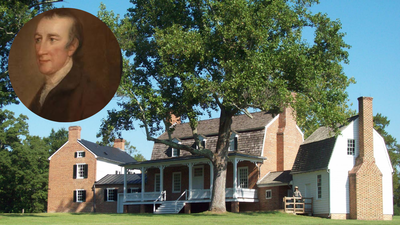
A historic Maryland plantation once bought for £400 by a signer of the American Declaration of Independence has survived centuries of private family ownership and a nearly fatal house fire to become a national historic site. The Haberdeventure estate, near Port Tobacco in Charles County, Maryland, remained in the hands of Thomas Stone and his descendants for 166 years. Today, preserved as the Thomas Stone National Historic Site, the property offers a look at early American history and the way land was owned and passed down.
Early land trades and survey errors
Long before American independence, the land changed hands many times. According to historical records published by the National Park Service, a 150-acre plantation called “Habberdeventure” was first established by John Barefoot. His family cleared forests and built the first farm structures. In 1708, John Lambert bought the property for 500 pounds of tobacco, several casks and other considerations. Land records show that by 1724, Charles County resident Robert Hanson had acquired the site for 2,000 pounds of tobacco and five barrels of Indian corn. The property grew much larger in 1768 under Hanson’s daughter Mary and her husband Daniel Jenifer, who was Thomas Stone’s uncle. According to National Park Service historical accounts, land surveys in the 18th century were often inaccurate. They depended on landmarks that could disappear or change, such as a stone at the foot of a thorn bush, locust posts or witness trees. When Jenifer carried out a new survey in 1768, he claimed nearby areas of unclaimed land that had been created by earlier boundary errors. This allowed Jenifer to double the estate’s size to 442 acres without paying additional fees.
A signatory purchases Haberdeventure
In 1770, Thomas Stone bought the 442-acre Haberdeventure property from his uncle for £400 British sterling. Stone was a lawyer who later represented Maryland in the Continental Congress and signed the Declaration of Independence in 1776. He expanded the farm to 1,077 acres before his death in 1787. The name Haberdeventure originally came from the Latin phrase Haber de Venture, loosely translated as a dwelling place of the winds. Stone built his home on the estate, creating a family home that stayed in his family for generations. Official records from the National Park Service show that the Stone family kept ownership of the plantation for 166 years before selling the estate in 1936. After the property left the family, it gained federal recognition and was listed as a National Historic Landmark in 1972.
Blaze damages the historic manor
The historic site came close to being destroyed completely on the evening of 1 January 1977. At 9:43 pm, the La Plata Fire Department received an urgent alarm reporting that the main house at Haberdeventure was on fire. Firefighters brought the fire under control shortly after reaching the scene. According to National Park Service documents, La Plata Fire Department Chief Gary Echols said at the time: “If we had arrived five minutes later the whole thing would have gone.” An official investigation found that the fire had started accidentally, although investigators never reached a conclusive final decision about the exact cause. Park docents working at the house in late 1976 said the central furnace was not working properly at the time. This meant people had to use open fireplaces for heat. Officials said an escaped ember from a fireplace or an unattended candle likely started the fire.
Transition to a federal historic site
After the fire, federal authorities took steps to protect the historic property permanently. The United States Congress designated the estate as the Thomas Stone National Historic Site in 1978. The National Park Service bought the property in 1981 to carry out major restoration work on the fire-damaged manor and the surrounding grounds. After years of preservation work, the site officially opened to the public in 1997. Today, the national historic site covers 328 acres, or about 70 per cent of the original 442-acre parcel Stone bought in 1770. Visitors can use walking trails, see historic outbuildings and visit the Stone family cemetery, where the Declaration signer and his wife, Margaret, are buried.