










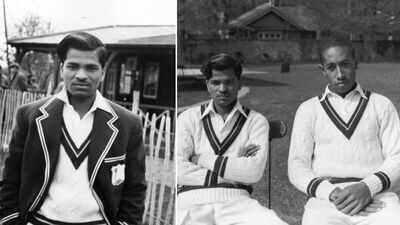
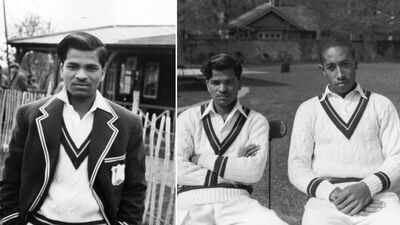
Sonny Ramadhin became the first cricketer of Indian origin to represent the West Indies when he made his Test debut at Old Trafford during the 1950 tour of England.Born in St Charles Village in Trinidad, not far from the capital Port of Spain, Ramadhin lost both his parents when he was a toddler. He was raised by his grandparents, who had migrated from India to work on one of Trinidad’s cocoa estates.Ramadhin did not have a first name when he was born. He was simply called “boy” during his childhood. Over time, that became “Sonny”, and the name stayed with him.Then something unusual happened during the 1950 tour of England. In Ramadhin’s own words: “When I got to England they insisted that nobody could go through life without initials. The next time I picked up the paper I’d become KT Ramadhin. I never did find out what my new English names were supposed to be!”No matter what the English newspapers called him, he remained Sonny Ramadhin — the mystery spinner from the Caribbean who made the cricket world take notice in 1950.
The spin twins
Ramadhin and fellow spinner Alf Valentine became one of the biggest reasons behind West Indies’ famous 3-1 Test series win over England in 1950. It was the first time the West Indies defeated England in England in a Test series.What made their story even more remarkable was their lack of experience. Before the England tour, both Ramadhin and Valentine had played only two first-class matches each — both trial games for selection.England had prepared for the famous Three Ws — Frank Worrell, Everton Weekes and Clyde Walcott — who formed the backbone of West Indies’ batting. What England had not prepared for was a pair of spinners with completely different styles.Ramadhin was famous for bowling both off-breaks and leg-breaks with almost no visible change in his action. Valentine bowled left-arm orthodox spin.
Test debut at Old Trafford
Ramadhin and Valentine made their Test debuts together in the first Test at Old Trafford, Manchester, on June 8, 1950.West Indies lost that match by 202 runs, even though the pitch offered plenty of help for spin bowlers. Together, Ramadhin and Valentine took 15 wickets in the match, but England’s spin trio of Jim Laker, Eric Hollies and Bob Berry used the conditions better.The defeat, however, was only the beginning of a historic series.
Lords of Lord’s
The second Test at Lord’s became one of the most iconic matches in West Indies cricket history. West Indies scored 326 in the first innings, thanks largely to Allan Rae’s century. Ramadhin and Valentine then bowled England out for just 151.West Indies declared their second innings at 425 for 6 and set England a target of 601 runs.At the start of the final day — a Thursday — there were very few spectators at Lord’s. Most of them were West Indians, and there were fewer than 100 in the crowd.England resumed at 281 for 4, chasing what was almost an impossible target.By lunch they had lost five more wickets. Shortly after 2.18 pm, Johnny Wardle was trapped lbw by Frank Worrell, and West Indies completed a 326-run victory, their first Test win over England in England. Ramadhin was the star of the match.He finished with figures of 5 for 66 in the first innings and 6 for 86 in the second. Valentine supported him with figures of 4 for 48 and 3 for 79.West Indies went on to win the remaining two Tests as well — by 10 wickets at Nottingham and by an innings and 56 runs at The Oval — to seal the series 3-1.
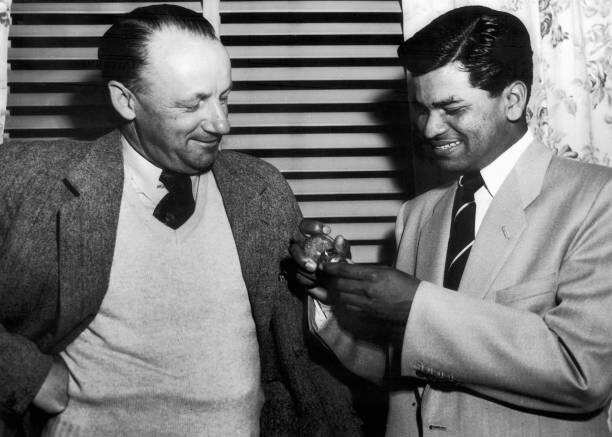
West Indies spin bowler Sonny Ramadhin demonstrating his mystery grip to an intrigued Donald Bradman in Brisbane during the Test Match, early 1950’s. (Photo/Getty Images)
Those two little pals of mine …
The victory at Lord’s was iconic. But more iconic were the celebrations that followed.A small group of West Indian supporters ran onto the field carrying “guitar-like instruments”, according to The Times. They danced, sang calypsos and created music using dustbin lids and even a carving knife scraped across a cheese grater.Among those supporters were Lord Kitchener and Lord Beginner, who had arrived in Britain aboard the Empire Windrush in 1948 as part of the first major wave of Caribbean immigrants.Lord Kitchener had been singing calypsos throughout the Test match. After the victory, he came up with lines that celebrated the heroes of the day:Walcott, Weekes and Worrell held up their nameWith wonder shots throughout the gameBut England was beaten clean out of timeWith the spin bowling of Ramadhin and Valentine.Those lines eventually became part of Cricket, Lovely Cricket, one of the most famous songs associated with West Indies cricket.There has been some confusion over who actually wrote the song. It was recorded and released by Lord Beginner, but there’s some strong evidence to suggest that it was created jointly by Lord Beginner and Lord Kitchener.Former Southwark mayor Sam King, who was present at Lord’s that day, recalled the moment in a 1998 interview with The Guardian.“I was about going home, about 20 voices said, Sam, you can’t go home, man. Kitchener going to make a song.’ I said, What?’ They said, Just come.’ We sat down on the grass and Kitchener says, Cricket, lovely cricket,’ and someone said, Put Ramadhin in, man.’ And he put Ramadhin in, and he went over it, and in 30 minutes he wrote the song, Cricket, lovely cricket, at Lord’s, where I saw it. Yardley won the toss, but Goddard won the Test, with those little pals of mine, Ramadhin and Valentine.‘ I was there. That was history.”Whether it was written by one person or together, Cricket, Lovely Cricket became part of West Indies cricket folklore. The first stanza of calypso reads:Cricket lovely Cricket,At Lord’s where I saw it;Cricket lovely Cricket,At Lord’s where I saw it;Yardley tried his bestBut Goddard won the test.They gave the crowd plenty fun;Second Test and West Indies won. With those two little pals of mine, Ramadhin and Valentine.
More than a one-series wonder
Ramadhin remained one of West Indies’ mainstay through the 1950s. He was the leading wicket-taker in the 1953-54 home series against England, taking 23 wickets at an average of 24. Two years later, in New Zealand, he picked up 20 wickets at an average of 15.When West Indies returned to England in 1957, Ramadhin was still their biggest bowling weapon.In the first Test at Edgbaston, he produced the best innings figures of his Test career, 7 for 49. During one spell after lunch, he took 6 wickets for just 9 runs in eight overs.However, England responded tactically in the second innings.Peter May and Colin Cowdrey repeatedly stretched forward, using their pads to smother Ramadhin’s spin because they believed lbw decisions would not be given.With two West Indies bowlers injured, captain John Goddard kept Ramadhin bowling almost continuously. Ramadhin bowled 98 overs in that innings, which remains a Test cricket record. Despite many appeals, the umpires didn’t give any lbw in that innings.Ramadhin later became eligible to play county cricket after settling in England, and joined Lancashire in 1964.He also played Minor Counties cricket for Lincolnshire into his early forties and continued playing league cricket until he was nearly 50.After representing Lancashire and spending years in the Lancashire leagues as a professional, he settled permanently in north-west England following his retirement.He died on February 26, 2022, at the age of 92. A star of his time, Ramadhin, the first Indian to play for West Indies, claimed 158 wickets from 43 Tests during a 10-year international career.
Do you think the strategic use of spin bowlers like Ramadhin changed the course of cricket?
3k+ users shared opinion today
5k+ users already voted today
3k+ users shared opinion today