










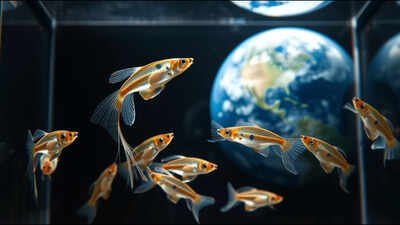
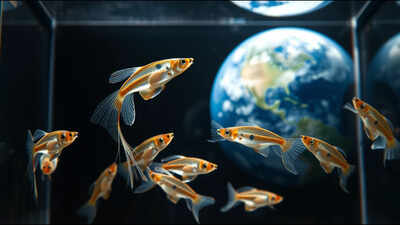
On December 14, 1983, the Soviet Union launched an unmanned biosatellite called Cosmos 1514, carrying more than 60 experiments from nine countries, including 2 rhesus monkeys, 10 pregnant rats and a small group of fish. Among the passengers were 3 pregnant guppies, a common livebearing fish, sent into orbit to see how weightlessness would affect their developing embryos. The mission lasted just 5 days before the capsule returned to Earth. According to a study titled Embryonic development of guppies in weightlessness, the guppies were already carrying embryos at an early stage of development, when the brain and body segments were just beginning to form, at the time of launch. Researchers wanted to know whether spaceflight during this delicate stage would disrupt normal growth, and the results, recorded after the fish returned, turned out to be reassuring for anyone hoping animals could reproduce safely in orbit.
How the guppy experiment aboard Cosmos 1514 worked
The three pregnant females were flown aboard Cosmos 1514 for five days, giving researchers an opportunity to examine embryos that had spent part of their development in weightlessness. The study was specifically focused on embryonic development rather than whether the fish could give birth in space. Before launch, the embryos were at the stage of cerebral vesicle differentiation and somite formation. After the biosatellite returned, one female was fixed in Bouin’s fluid two days after the flight, while a second was fixed nine days after the flight. These specimens allowed researchers to examine the embryos histologically at different stages following their exposure to weightlessness. The third female was kept alive so that researchers could observe the eventual outcome of her pregnancy and follow the health of her offspring. Nasa‘s archival record of the experiment also notes that flight and control groups were maintained under comparable temperature and feeding conditions.
What happened when the surviving guppy gave birth after returning from space
Fourteen days after the flight, the third guppy gave birth to 25 fry. The original study described all of them as normal. The same female then mated six more times and produced normal offspring each time. Researchers also examined the offspring of the next generation and reported that they were normal as well. This extended follow-up was significant because the experiment did not end with the first birth. The researchers were able to observe repeated reproductive success from the female after her exposure to weightlessness and then check whether abnormalities appeared in the following generation. None were reported. The experiment therefore provided evidence that the five-day exposure to weightlessness had not prevented the embryos carried by the female from continuing normal development after her return to Earth.
What the guppy study revealed about embryonic development in weightlessness
The histological examination of the embryos from the first two females found no developmental abnormalities. The study concluded that weightlessness had produced no detectable effect on fish development beginning at the stage of axial complex formation. That conclusion is narrower than saying spaceflight has no effect on reproduction in general. The experiment involved only three pregnant guppies, and the surviving female gave birth after returning to Earth rather than in orbit. What it showed was that embryos already undergoing early development could continue developing normally after their mothers had spent five days in weightlessness, with the female later producing repeated normal broods. The normal second generation provided additional evidence that no obvious reproductive abnormality had been carried forward. The experiment became part of the broader Soviet research programme investigating how weightlessness affects development and reproduction in animals.
Why Cosmos 1514 mattered to Soviet space-biology research
Cosmos 1514, also known as Bion 6, was part of the Soviet Bion programme, which used biosatellites to investigate the effects of spaceflight on living organisms. The guppy experiment was one part of a much wider mission involving other biological studies, including research on pregnant rats and the development of their offspring. Nasa’s archival records list the 1987 guppy paper among Soviet research on developmental biology and reproductive biology conducted through the Cosmos programme. For the guppies, the result was unusually clear: embryos that had experienced five days of weightlessness showed no abnormalities when examined after the flight, and one female subsequently produced 25 normal fry followed by six more normal broods. Her offspring were also reported to develop normally.