










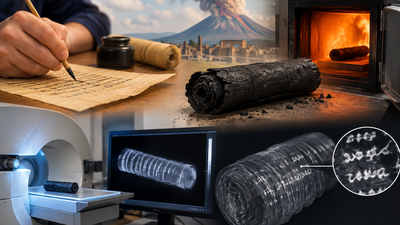
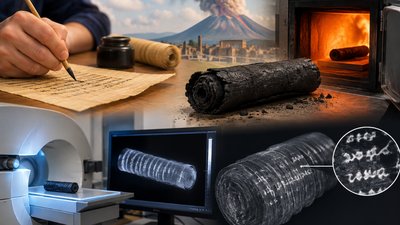
What if the best way to understand a 2,000-year-old burned scroll is to make one yourself and set it on fire? Scientists did just that to investigate how writing might be recovered from carbonised papyrus scrolls buried by the eruption of Mount Vesuvius. In a study published in PLOS ONE, researchers created modern papyrus scrolls, wrote on them with ink containing different amounts of lead and then carbonised them in a low-oxygen environment. The experiments showed that leaded ink could stand out dramatically in X-ray scans, offering a possible way to identify ancient scrolls whose hidden writing may be recoverable.
Recreating a disaster from antiquity
The experiment was designed around one of archaeology’s most difficult collections: the Herculaneum scrolls. When Mount Vesuvius erupted in 79 CE, volcanic material overwhelmed Herculaneum, an ancient Roman town near modern Naples, Italy. Among the material buried was a library containing more than a thousand papyrus scrolls.The extreme heat did not simply destroy the scrolls. Instead, it carbonised them, turning the papyrus into fragile, blackened objects. The process preserved the scrolls in a severely damaged state, but it also created a major problem for researchers: opening them can cause further damage or destroy them altogether. The collection is especially important because it represents the only known intact library from antiquity. Many of the texts inside the scrolls may contain information that has never been read in the modern era. Researchers have therefore been developing methods to look inside the scrolls without physically unrolling them.
Why ordinary ink is difficult to see
One of the biggest challenges is the material itself. Ancient carbon-based ink and carbonised papyrus can look remarkably similar when examined using X-ray techniques. Because both contain carbon, the contrast between writing and the surrounding papyrus can be extremely weak. That makes it difficult for X-ray CT scans to distinguish individual letters, even when the scans successfully capture the complicated layers of a tightly rolled scroll. The Berkeley-led research explored whether a different ingredient in some inks could solve that problem: lead.Lead is much denser than carbonised papyrus and interacts with X-rays differently. If lead is present in the ink, the written letters can produce a much stronger signal in an X-ray scan. The researchers found that the lead in their experimental ink absorbed up to 25 times more X-rays than the surrounding charred papyrus, making the writing stand out clearly.
Students helped create the test scrolls
To test the idea, researcher Douglas Seiler sourced papyrus and reed pens and prepared ink containing different concentrations of lead. High school students were then asked to write passages on the modern papyrus. The material included lines from Star Wars, passages from the Bible and a quotation from the 1960s science-fiction television series The Outer Limits.The researchers then rolled the papyrus into scrolls and placed them inside a container with very little oxygen. They heated the scrolls in a high-temperature furnace, producing carbonised replicas designed to resemble the physical condition of the ancient Herculaneum material. The point was not to recreate every detail of the ancient eruption. Instead, the model gave scientists something they could safely experiment on. Unlike a priceless archaeological artefact, the modern scrolls could be burned, scanned and processed repeatedly without putting an irreplaceable historical object at risk.
X-rays revealed the hidden writing
After carbonisation, the experimental scroll was examined using X-ray techniques. The researchers used X-ray computed tomography, or X-ray CT, to produce thousands of images that could be combined into a three-dimensional representation of the scroll. Because lead absorbs X-rays much more strongly than carbonised papyrus, the lead-containing letters appeared as significantly brighter features within the scan.The researchers reported that lead concentrations as low as 25 micrograms per square centimetre could be detected using both X-ray CT and X-ray fluorescence. This is important because it suggests that researchers may not need to begin by trying to decipher every surviving scroll individually. Instead, they could first screen the collection for evidence of lead-containing ink and then prioritise the scrolls where the X-ray contrast is likely to be strongest.
From scanning to virtually opening a scroll
Detecting the letters is only part of the problem. A scroll consists of many tightly packed layers of papyrus. Even if an X-ray scan captures the writing, researchers still need to separate those layers computationally and reconstruct the surface on which the letters were written. This is where virtual unrolling comes in. The researchers tested software originally developed to map the internal layers of lithium-ion batteries. The programme was adapted to follow the complicated geometry of the carbonised scroll and produce an unfolded representation of its surface. The experimental scroll provided something particularly useful for developing such technology: researchers already knew exactly what text had been written on it. That allows them to compare the original writing with the computer-generated reconstruction and determine how effectively the software can recover letters hidden inside a damaged, rolled-up object.
What it could mean for the Herculaneum library
The research does not mean that scientists have already read previously inaccessible Herculaneum scrolls using this particular technique. Instead, the study provides a potential method for identifying which scrolls could be easier to decipher with X-ray CT and virtual unrolling. Only a small number of Herculaneum scrolls have so far been virtually unrolled and read. Previous breakthroughs have relied on artificial intelligence and machine-learning systems capable of detecting extremely subtle differences associated with ancient ink.The new approach could provide a stronger signal when lead is present. Researchers suggest that an inexpensive handheld X-ray fluorescence scanner could potentially be used as an initial screening tool. Scrolls showing evidence of lead could then be selected for more detailed X-ray CT imaging. That could give researchers a way to narrow a huge archaeological collection down to the specimens most likely to yield readable text.
A safer path to lost ancient writing
The significance of the experiment extends beyond the specific modern scrolls that were burned. The Herculaneum papyri are extraordinarily fragile, meaning researchers have to balance the desire to recover their contents with the responsibility to preserve the objects themselves. Physically opening a carbonised scroll can cause irreversible damage. Model scrolls offer a safer testing ground for improving the technology.Scientists can experiment with different ink compositions, carbonisation conditions, scanning techniques and computer algorithms on replicas before applying those methods to ancient artefacts. If lead-containing ink is found in surviving Herculaneum scrolls, the strong X-ray signal demonstrated by the experiment could make some of those texts considerably easier to detect and reconstruct. The ultimate goal is therefore not simply to look inside an ancient scroll. It is to recover words that have remained hidden since the eruption of Vesuvius nearly two millennia ago, without having to physically open the fragile objects that preserved them.