












NEW DELHI: Employees Provident Fund Organisation (EPFO) on Thursday decided to let retiring members opt for a systematic withdrawal plan (SWP) – giving them the opportunity to withdraw only a part of their corpus and earn interest on the remaining amount. Till now, members had to withdraw the entire corpus within three years of retirement.Separately, in case of partial withdrawals – a year after mandating that 25% of the corpus must be kept as minimum balance with EPFO – it decided to dilute the rule and allowed members to withdraw 90% of their corpus for three specified categories – essential needs (illness, education, marriage); housing needs; and special circumstances. Besides, it also slashed the waiting period in case of withdrawals made during the period of joblessness to two months, instead of 12 months earlier. “(EPFO) approved the provisions relating to the minimum balance requirement and waiting period for withdrawal, with a view to safeguarding the long-term social security interests of EPF members,” the retirement fund body stated.
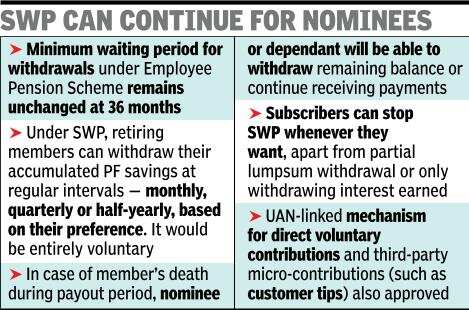
Under SWP, retiring members can withdraw their accumulated PF savings at regular intervals, such as monthly, quarterly or half-yearly, based on their preference. Subscribers will also have the option to stop SWP whenever they want, apart from partial lumpsum withdrawal or only withdrawing the interest earned.The SWP facility would be entirely voluntary, thus ensuring stable post-retirement income, reducing reinvestment risks and strengthening fund sustainability. The minimum waiting period for making withdrawals under Employee Pension Scheme (EPS), however, remains unchanged at 36 months.Around 6.3 lakh EPF members aged above 55 years with provident fund accumulations of over Rs 5 lakh are expected to be primary beneficiaries of the proposed SWP framework. In case of the member’s death during the payout period, a nominee or dependant will be able to withdraw the remaining balance or continue receiving periodic payments.TOIreported about this in a frontpage report Thursday.Vineet Nahata, MD, Power Gilt Treasuries, and member of Central Board of Trustees, said members will now get completely secure fixed income investment avenue with attractive interest earning, that too tax exempt till Rs 2.5 lakh annually. “It is a superior investment alternative compared to bank fixed deposits and mutual funds which are prone to credit risk and market fluctuations,” he said.Additionally, in a move towards achieving universal social security, EPFO approved the introduction of a UAN-linked mechanism for direct voluntary contributions and third-party micro-contributions (such as customer tips), completely independent of traditional employer payroll systems. This will help people in the unorganised sector to accumulate their own PF savings, independent of any employer contributions.With a view to diversifying EPFO’s investment portfolio and generate higher returns for its 30 crore members, the social security organisation also decided to permit investments up to 3% of its fresh annual accretions in eligible alternative investment funds. It can invest up to 5% of its fresh annual accretions in asset-backed and trust-structured investments, according to its pattern of investment. Initially, the plan is to channel worker capital through institutional giants such as National Investment and Infrastructure Fund and Sidbi’s Startup India Fund of Funds 2.0.CBT also reviewed proposals for 27 establishments to surrender their EPF exemptions status and four establishments to have their exemption cancelled, transferring corpus of around Rs 6,000 crore, covering 1.5 lakh members, to EPFO’s direct administration. Exempted establishments manage PFs on their own in accord with EPFO norms.