











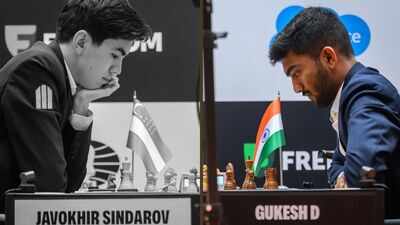
NEW DELHI: “Sindarov has a 60 min advantage over Gukesh. What did Gukesh’s team do all this time for the last 2 years?” A random post on X was enough to gauge the tension in the air as two 20-year-old prodigies, Javokhir Sindarov and Dommaraju Gukesh, locked horns in a taut, high-wire curtain-raiser at the 2026 World Chess Championship in Cologny, Switzerland.Minutes later, another screenshot made the rounds. It was not fake or AI-generated. By move 17, the reigning world champion, with Black, was staring at a dwindling 29:51 on his clock, while his Uzbek challenger sat comfortably behind a fortress of over an hour and eighteen minutes.Before move 40, there is no increment, and the math seemed brutal as the titleholder was already staring down the barrel of severe time trouble.Blitzing through the opening stages to turn the clock into a weapon has become Sindarov’s calling card. Earlier this year in Cyprus, wielding the very same high-tempo blueprint, the Uzbek grandmaster tore through the Candidates field like a whirlwind.On Tuesday, playing with the white pieces, which gives the first-move advantage, he looked poised to run that exact playbook once again.Asked afterwards about the ticking clock, Gukesh replied, “I thought I was always under control, or at least not in a place where I really needed to be worried… I was happy that I managed to spend some time and find a good solution (to the opening problems)!”
How the game unfolded
The battle took place in a famous chess setup known as the Berlin Endgame, a notoriously solid, defensive strategy where the queens are traded off early.While it is usually a safe choice, Gukesh rarely plays it, which raised eyebrows.Sindarov wasted no time taking the game into uncharted territory, playing a surprise knight move on turn 13 (13. Ne4) that had never been seen in a top-level in-person tournament before.As Dutch Grandmaster Anish Giri noted in his post-game breakdown, the players skipped the usual middle part of a chess game entirely, jumping straight into a tense, high-stakes endgame.“White has a lot of initiative… very dangerous position for Black,” Giri said on his YouTube channel.Sindarov’s pieces were swarming forward, while one of Gukesh’s most powerful pieces, his rook in the corner, remained trapped and unable to join the fight.Forced onto the back foot and burning precious minutes to calculate every danger, Gukesh found a clever defensive setup on moves 17 and 18 (17…Bb4 and 18…h6).By pinning Sindarov’s pieces in place and blocking his path forward, the Indian champion brought White’s attack to a grinding halt.Sindarov still held a slight edge and could have kept building the pressure slowly. Instead, on move 24, he pushed a pawn forward aggressively (24. f4), triggering a fast trade of pieces that accidentally gave Gukesh the escape route he needed.Gukesh responded with cold-blooded accuracy, giving up a pawn to free his king and finally bring his trapped corner rook into the action.“All Black’s other pieces are good, but the rook on h8 is not in the game,” Giri observed. “As soon as the king was able to move up and connect these rooks, bring this rook into play… the opening was essentially over.”Once Gukesh’s army was working together, the danger disappeared.In fact, Sindarov had to make one very careful defensive move late in the game to avoid falling into a trap, before forcing a draw by repeating the same moves three times, a standard way chess games end in a tie when neither side can make progress.Neither player made a single major mistake across all 38 moves.
Praise from top Grandmasters
The high-wire accuracy drew immediate acclaim from fellow grandmasters on X.Grandmaster Srinath Narayanan wrote: “High quality game one, fitting of a world championship match. Love the amount of watching and interest, again fitting of a world championship match!”Grandmaster Rameshbabu Praggnanandhaa posted, “Incredible 1st game of World Championship match! High quality game from both! Gukesh found great moves under pressure! Excited to follow game 2”Grandmaster Vidit Gujrathi also joined in, adding, “A very high quality game considering the pressure of an opening round match. Sindarov showed a new opening idea but Gukesh found good moves, although he was dangerously low on time at some point. There was a lot of tension throughout the game, so very interesting to watch as a fan of the game.”While the scoreboard reads half-a-point apiece after a remarkably clean opener, it is Gukesh who will rest easier in Cologny tonight, having survived an early storm with the defensive black pieces before getting the attacking white pieces in Game 2.On the FIDE broadcast, commentator Grandmaster Peter Leko summed up perfectly, “We should say that Gukesh is the winner of the game psychologically because playing with the black pieces, he got under pressure, but he navigated all the difficulties, knowing that he had a rough year, facing a challenge in the very first game, and being uncomfortable not being able to show his prep, and then played the way he did. I think this is the boost he needed.”