










Every morning during spring and summer in Mars’s southern hemisphere, a long white cloud appears downwind of the giant volcano Arsia Mons. The Arsia Mons Elongated Cloud, or AMEC, can stretch up to 1,800 kilometres before fading, a length the European Space Agency (ESA) compares with nearly twice the length of the UK. The cycle repeats each morning for several months. For years, scientists struggled to reproduce the cloud’s distinctive features in computer simulations. Now, a study published in Nature Geoscience suggests an unexpected explanation: the cloud may form through a process in which water vapour turns directly into ice without needing pre-existing particles such as dust. The researchers used observations from the European Space Agency’s Mars Express spacecraft alongside a meteorological model. Their results strongly suggest that this process, known as homogeneous ice nucleation, occurs on Mars, although the mechanism has not been directly observed.
Arsia Mons Elongated Cloud on Mars: how a 1,800-kilometre water ice cloud forms
The AMEC is a water ice cloud that develops downwind of Arsia Mons, a giant Martian volcano that ESA describes as about 20 kilometres high. ESA reports that the cloud can reach 1,800 kilometres in length. It reappears in the morning during the southern hemisphere’s spring and summer, then dissipates as the day progresses. The cloud is an example of an orographic cloud, which forms when air flows over elevated terrain. The simulations indicate that air flowing over Arsia Mons produces a strong atmospheric wave. As moist air rises rapidly, it cools and its relative humidity increases, creating conditions that may allow ice to form. The combination of the volcano’s height and Mars’s thin atmosphere creates conditions that the model identifies as suitable for the cloud’s formation.Earlier simulations using conventional cloud-formation processes struggled to reproduce the AMEC’s observed characteristics. Under the usual explanation, water vapour forms ice on pre-existing particles suspended in the atmosphere. This process is called heterogeneous nucleation. On Mars, airborne dust is thought to provide some of these surfaces. The new study, Homogeneous ice nucleation from water vapour suggested by elongated clouds on Mars, published on October 7, 2026, proposes that the AMEC may form without this requirement. Its explanation depends on the extreme atmospheric conditions produced as air rises beside Arsia Mons.
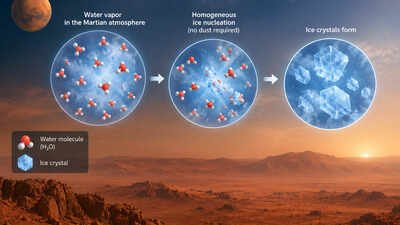
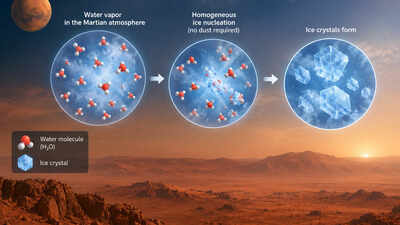
Homogeneous ice nucleation on Mars: how water vapour can form ice without dust
Lead author Jorge Hernández-Bernal, affiliated with the Laboratoire de Météorologie Dynamique and Sorbonne Université in Paris, and his colleagues investigated whether homogeneous ice nucleation could explain the cloud. In this process, ice particles form directly from water vapour without relying on pre-existing particles to initiate their formation. The distinction matters because homogeneous nucleation requires exceptionally high levels of supersaturation, when the amount of water vapour exceeds the equilibrium amount under the prevailing conditions. It has been considered theoretically possible in the upper atmospheres of Earth and Venus, but has not previously been observed in nature in a planetary atmosphere.The researchers incorporated homogeneous ice nucleation into a meteorological model of Mars. With this process included, the simulations reproduced key characteristics of the AMEC that had proved difficult to reproduce using conventional cloud microphysics alone. The results strongly suggest that the cloud’s formation involves homogeneous nucleation. The findings do not mean that scientists directly watched individual ice crystals form without dust. Instead, the proposed mechanism explains the cloud’s observed behaviour within a model. The authors also report that some features of the simulated cloud do not match the observations exactly. The study therefore offers evidence for a process that atmospheric scientists have generally considered unlikely under real planetary conditions. It also suggests that the extreme humidity needed for homogeneous ice nucleation may occur in Mars’s atmosphere, even though such conditions had not previously been observed there.
Mars Express observations of the Arsia Mons cloud and implications for other planets
The observations used in the research came from ESA’s Mars Express spacecraft, which has monitored the cloud over several years. Mars Express has observed the recurring cloud over several years. In September 2018, its Visual Monitoring Camera began a detailed series of observations that helped scientists document the cloud’s daily evolution. For the study, the researchers used data from 3 Mars Express instruments: the Visual Monitoring Camera, the High Resolution Stereo Camera and OMEGA, the Visible and Infrared Mineralogical Mapping Spectrometer. Together, these instruments provide observations that help researchers examine the cloud’s appearance and its relationship with the Martian atmosphere and surface.Mars Express can observe the planet during the morning hours when the cloud is present. ESA’s ExoMars Trace Gas Orbiter also has an orbit that allows observations during these hours. The timing matters because the cloud develops and fades over a relatively short period. ESA Mars Express project scientist Colin Wilson said the mission could track changes in the cloud over timescales of hours, helping scientists study short-lived atmospheric phenomena. The new work builds on years of observations by using them to test a possible explanation for how the cloud forms.The implications could extend beyond Mars. If homogeneous ice nucleation can occur under real atmospheric conditions on the planet, scientists may need to consider the process when modelling clouds in other environments. The findings may also prompt researchers to reconsider cloud-formation processes in some Earth and planetary atmospheres. However, the study does not establish that homogeneous ice nucleation occurs in those environments. The research was supported by the French space agency CNES and the European Research Council. For now, the key result is that a model incorporating homogeneous ice nucleation can reproduce important features of one of Mars’s most striking clouds. Further work will be needed to test the proposed mechanism and determine how broadly it applies.