










Human excreta and poorly utilised livestock excreta contain enough nitrogen, phosphorus and potassium to represent about 13% of the nutrient needs of crops and grasslands worldwide, according to a global analysis published in Nature Sustainability. In the study titled Nutrient recycling potential of excreta for global crop and grassland production, researchers at Cornell University examined how much of these nutrients could potentially be recovered and returned to agriculture. The analysis found that the nitrogen, phosphorus and potassium contained in human and poorly utilised livestock excreta represented 16%, 8% and 14%, respectively, of global crop and grassland requirements, with the combined figure reported by Cornell as 13% for the major nutrients. The researchers also modelled how national recycling could reduce global net imports of mineral fertilisers by 41% for nitrogen, 3% for phosphorus and 36% for potassium. These figures describe the potential contribution of recycling under the study’s model, rather than an amount currently being recovered.
Researchers mapped nutrient flows across as many as 146 countries
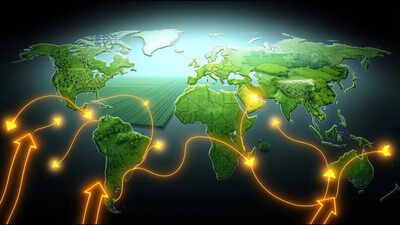
The analysis was led by Mariana Devault, a doctoral researcher at Cornell, with Dominic Woolf and Johannes Lehmann as co-authors. The team combined data from several sources, including the United Nations Food and Agriculture Organization’s FAOSTAT database and the International Fertiliser Association’s STAT database, along with satellite-based maps showing the locations of crops and livestock. The researchers used these datasets to estimate fertiliser use and the quantities of nutrients accumulating in human and livestock excreta across as many as 146 countries. A key part of the work was estimating nutrient flows at the subnational level before drawing conclusions at national and global scales. Devault explained that this was important because the cost of transporting livestock excreta can make it impractical to move nutrients long distances, meaning that some material is poorly utilised even when it is produced in agricultural areas. The study therefore considered where nutrients are generated and where agricultural systems need them, rather than treating all excreta as if it could simply be transported anywhere.
Recycling could reduce dependence on imported mineral fertiliser
The researchers then modelled how much of the nutrients in excreta could contribute to crop and grassland production if poorly utilised material were recycled. Their results indicate that national recycling of the available nutrients could reduce global net imports of mineral fertilisers by 41% for nitrogen, 3% for phosphorus and 36% for potassium. The potential is not distributed evenly, however. The study found that in countries where locally available livestock excreta and mineral fertilisers together do not meet crop and grassland nutrient requirements, recycling poorly utilised excreta could reduce the remaining nutrient gap by an average of 20% for nitrogen, 11% for phosphorus and 13% for potassium. This means recycling could make a particularly important contribution in some places while having a smaller effect in others, depending on where livestock are raised, where crops are grown and how much fertiliser is already being applied.
Nutrients that are lost can become environmental pollutants
The potential benefit is not limited to replacing mineral fertiliser. When nutrients in human or animal waste are poorly managed, they can enter surrounding water and soil systems instead of returning to agriculture. Cornell reported that Johannes Lehmann said recycling excreta could help divert nutrient runoff from local water sources, where excess nutrients can contribute to pollution and harmful algal blooms, including those documented in New York’s Finger Lakes. The researchers frame this as part of a circular economy in which nutrients move from agriculture into food, through consumption and livestock production, and then back into agricultural systems. The study does not claim that recycling excreta automatically eliminates pollution, however. Effective reuse depends on recovering and managing the nutrients appropriately, while the feasibility of transporting livestock excreta remains an important practical constraint.
Fertiliser security also has energy and geopolitical implications
The researchers argue that nutrient recycling could also reduce some dependence on mineral fertiliser production. Lehmann described global fertiliser supply as a geopolitical issue comparable to oil, noting that phosphorus is a nonrenewable resource and that most phosphorus mining is concentrated in relatively few countries. Nitrogen fertiliser production, meanwhile, requires substantial energy, meaning its production is associated with a significant greenhouse-gas footprint. Lehmann told Cornell that, in theory, recycling human and animal excreta could satisfy current fertiliser use when considered alongside the nutrients already being supplied by other sources. That is a theoretical result, not a prediction that excreta could immediately replace conventional fertiliser worldwide. The study instead demonstrates the scale of a potentially recoverable nutrient resource and the extent to which better recycling could contribute to fertiliser security. Cornell also reported that Lehmann sees nutrient recycling becoming increasingly important as the global food system approaches the challenge of feeding close to 10 billion people around 2050.