










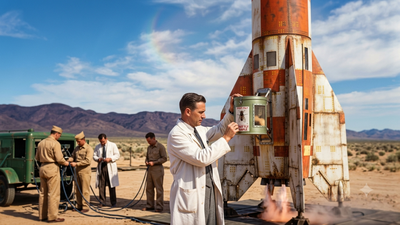
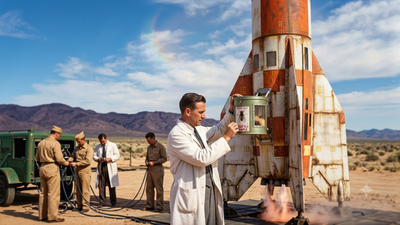
A tiny insect became one of the earliest living passengers sent towards space, long before astronauts were routinely orbiting Earth. In 1947, fruit flies were loaded onto a captured German V-2 rocket in New Mexico as scientists began testing what happened to life above the atmosphere. The experiment was primitive by modern standards, but it opened a scientific path that would stretch for decades. Fruit flies would later travel aboard space missions for very different reasons, helping researchers examine genetics, ageing, radiation and the effects of altered gravity. Eventually, scientists turned their attention to another question with consequences for humans: what happens to the immune system in space?
The 1947 rocket flight that sent fruit flies towards space
According to the Entomological Society of India (ESI), on 20 February 1947, fruit flies were loaded onto a captured German V-2 rocket at White Sands Missile Range in New Mexico. The rocket reached about 109 kilometres, carrying the insects in a small container alongside maize seeds.The experiment was not designed to answer the questions that dominate space biology today. Scientists were interested in what cosmic radiation might do to living organisms above the atmosphere. At the time, sending anything alive beyond Earth was itself a new idea.Fruit flies would appear in further high-altitude experiments during the 1950s, including missions using balloons and other vehicles. These early flights were limited and often rough by modern standards, but they helped establish biological experiments as part of space research rather than as an afterthought.
Fruit flies give space researchers a fast way to study genetics
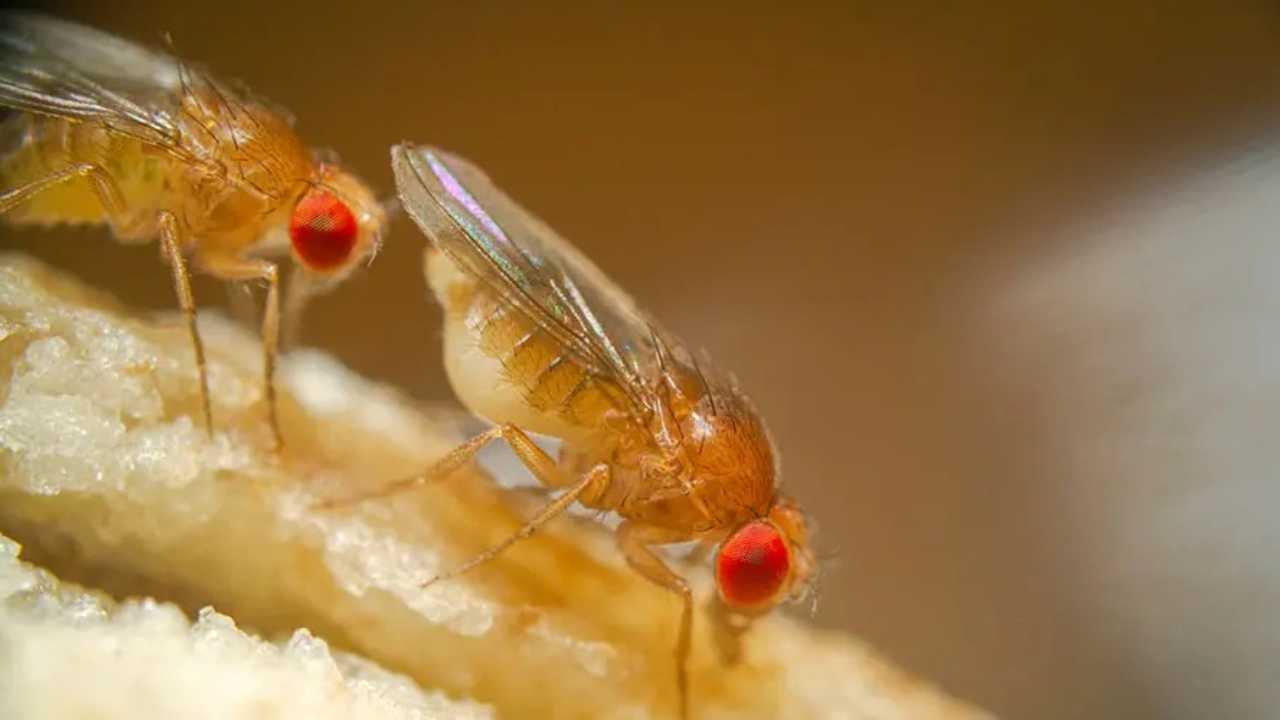
The appeal of the fruit fly has little to do with its connection to space and almost everything to do with what happens inside the laboratory.Drosophila has been studied genetically for more than a century. Scientists know an enormous amount about its development, reproduction and inheritance. Many genes involved in human diseases also have counterparts in flies, allowing researchers to investigate biological processes that would be far more difficult to study directly in humans.A researcher studying several generations of mice, for example, would need considerably longer. With flies, changes can appear and be compared within a much shorter mission window. Hundreds or thousands can also be maintained in a relatively small habitat, with modest requirements for food and oxygen.
PC: APS
Scientists began finding unexpected changes in flies sent into space
As biological missions became more sophisticated, scientists started looking beyond the immediate effects of cosmic radiation.Experiments during the 1970s linked radiation exposure and spaceflight with changes including mutations, ageing-related effects and damage to reproductive cells. Later work involving flies raised or born during space missions produced other observations. Some had shorter lifespans, while researchers also reported abnormalities involving the wings and changes in stored energy reserves.Launch and landing expose organisms to forces that do not exist once they are orbiting Earth, making it difficult to separate the effects of microgravity from the physical stresses of getting to and from space.A fly does not experience just one unusual condition. During a mission, it may encounter vibration, acceleration, altered gravity, radiation, confinement and changes in temperature or other environmental factors.
Fruit flies became a window into how space travel affects immunity
By the time fruit flies were being used in more controlled space experiments, attention had shifted towards biological systems that could have direct relevance to astronauts.The FIT (Fungal Immunity and Tumorigenesis) experiment flew aboard Space Shuttle Discovery’s STS-121 mission in 2006, examining how spaceflight affected the flies’ ability to respond to fungal infection. Findings from that experiment were later published in PLOS ONE in a 2014 study titled ‘Toll Mediated Infection Response Is Altered by Gravity and Spaceflight in Drosophila.‘The insects developed into adults during the 12-day mission, and those exposed to spaceflight showed impaired immune responses.That finding fitted a wider concern in human spaceflight. Astronauts can experience changes in immune function during missions, particularly when they spend extended periods away from Earth.The fly cannot reproduce the human immune system in every detail, of course. Its value lies elsewhere. If a basic biological pathway changes in both species, the insect can provide a much simpler system in which to investigate what might be causing that change.
A long experiment that started with a very small passenger
The history of fruit flies in space spans nearly eight decades, from a V-2 rocket in 1947 to specialised laboratories aboard the ISS and multigenerational experiments in modern spacecraft.Their contribution has never depended on size. A fly cannot tell scientists what a human astronaut will experience, but it can expose biological changes that would otherwise be difficult to isolate. Its rapid reproduction makes it possible to watch those changes unfold quickly, sometimes across several generations.That is why the insect keeps returning to space. As missions move from short stays in orbit towards longer journeys, researchers need organisms that can reveal what happens when gravity, radiation, confinement and time interact. The fruit fly remains one of the simplest ways to ask some of those questions.