










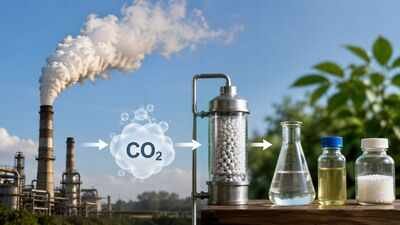
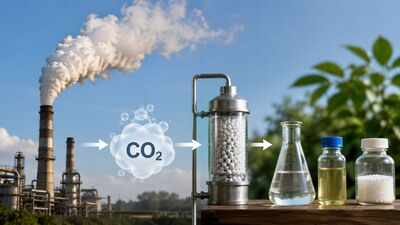
Industrial plants release vast amounts of carbon dioxide every day, yet much of the conversation around cutting those emissions has focused on capturing the gas and storing it underground. Turning it into something useful has always been a more attractive idea, but one that has struggled outside laboratory conditions. Factory exhaust is not made up of carbon dioxide alone. It also contains oxygen, nitrogen and other gases that interfere with chemical conversion processes, making direct use difficult and expensive. According to the new study published in Nature, titled “Hydrogen bond network disruption enables efficient direct reactive capture of CO2 from flue gas”, this obstacle may not be as fixed as previously thought. By redesigning the liquid environment where the reaction takes place, scientists have shown it is possible to convert carbon dioxide from untreated industrial exhaust into a valuable chemical feedstock without first separating and purifying the gas.
How the new system converts carbon dioxide without removing other gases first
Instead of concentrating on removing unwanted gases before conversion, the research team focused on changing the chemical environment where the reaction occurs.The scientists developed a direct reactive capture strategy using specially designed organic electrolytes. They identified the hydrogen-bond donation ability of the solvent as a key factor controlling competing reactions. By selecting electrolytes with weaker hydrogen-bonding behaviour, they disrupted the hydrogen-bond network inside the solution, reducing both hydrogen evolution and oxygen reduction while allowing carbon dioxide conversion to dominate.The system remained highly selective even when the gas stream contained only one per cent carbon dioxide alongside oxygen, conditions that closely resemble dilute industrial emissions.
Why converting carbon dioxide from factory exhaust is so difficult
Carbon dioxide electrolysis has attracted attention because it can transform captured CO₂ into products used for fuels and chemical manufacturing while running on electricity. The challenge has been the composition of industrial flue gas itself.Conventional electrochemical systems perform best with purified carbon dioxide. Industrial exhaust, however, usually contains relatively low concentrations of CO₂ together with significant amounts of oxygen. That oxygen competes with carbon dioxide during the reaction, while hydrogen evolution also diverts energy away from producing useful products. The result is lower efficiency and higher operating costs, making direct conversion difficult on an industrial scale.
Researchers demonstrate long-lasting carbon dioxide conversion from factory exhaust
Laboratory demonstrations often lose efficiency after relatively short operating periods, making durability an important test for any proposed carbon utilisation technology.According to Adelaide University, the researchers operated their system continuously for more than 100 hours using a simulated industrial flue gas containing 15 per cent carbon dioxide and eight per cent oxygen, with nitrogen making up the balance. Under those conditions, the process converted carbon dioxide into carbon monoxide with almost complete selectivity.The team also reported an energy consumption of 30.7 gigajoules for every tonne of carbon monoxide produced. Carbon monoxide is widely used as an industrial building block in the manufacture of synthetic fuels and numerous chemical products.
How the new technology could help cut industrial carbon dioxide emissions
The work could have practical implications for industries where carbon dioxide emissions are difficult to eliminate. Professor Yan Jiao said the organic solvent system weakens hydrogen bonding, suppressing unwanted reactions while favouring carbon dioxide conversion. She added that using carbon dioxide directly from industrial exhaust without extensive purification could make carbon utilisation more practical and potentially more economical for sectors including steelmaking, cement production, alumina refining, chemicals and energy generation. The researchers also connected the electrochemical system to a high-efficiency solar cell. The integrated setup achieved a solar-to-fuel efficiency of about 5.5 per cent, demonstrating that renewable electricity could potentially drive the conversion process.The approach is a step towards making direct carbon utilisation more tolerant of the mixed gas streams produced by industry. Rather than relying on energy-intensive purification before conversion, the findings suggest that carefully controlling the chemistry inside the electrolyte can allow valuable products to be generated directly from factory emissions, offering another possible pathway for reducing industrial carbon emissions while producing useful chemical feedstocks.