











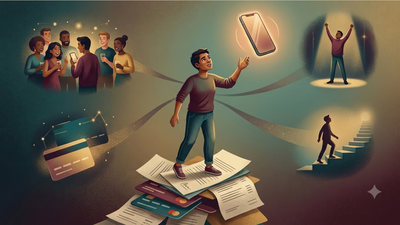
Apple has once again given the smartphone world something to talk about with the launch of its new iPhone 18 lineup. Within hours, conversations around the latest model have moved beyond its camera, design and new features to a much more familiar question: Who is upgrading, and why? Apple has launched the iPhone 18 Pro and iPhone 18 Pro Max in India. The Pro starts at ₹1,64,900, while the Pro Max starts at ₹1,79,900.There is a peculiar moment that happens after someone buys an iPhone they could barely afford. The excitement is real, but so is the calculation. The phone is finally in their hand, the box is open, the first photo is taken, and somewhere in the back of their mind is the EMI, the credit-card bill or the money they have just moved out of their savings.Yet the purchase can still feel completely worth it.That is what makes the iPhone craze more interesting than a simple story about smartphones. For some buyers, the device is no longer just a tool for calls, photos and social media. It can become a visible marker of success, taste, belonging and even self-worth. And psychology helps explain why people sometimes spend far more on a phone than their practical needs demand.
When a phone starts saying something about you
Imagine two people walking into a café. One places an old, perfectly functional smartphone on the table. The other puts down the latest iPhone.Nobody has heard either person speak yet, but the phone can already communicate something.Expensive objects often work as status signals. They can suggest that the owner has money, access to premium products or the ability to spend on things beyond basic necessities. The object becomes a shortcut through which other people form impressions.That does not mean every iPhone owner is trying to impress others. Many people genuinely prefer Apple’s software, cameras, ecosystem, privacy features or long-term support. But the psychological appeal of a premium brand can operate alongside those practical reasons.This is where an ordinary purchase becomes something more personal. The question shifts from “What can this phone do?” to “What does owning this phone say about me?”
The comparison nobody talks about
The urge to upgrade can become particularly strong when people look sideways.A colleague arrives with the newest model. A friend posts an unboxing video. A celebrity is photographed holding it. Someone in the family upgrades. Suddenly, a phone that worked perfectly yesterday can feel strangely old today.People naturally evaluate themselves partly by looking at others, particularly when there is no obvious objective measure of success. Technology makes that comparison unusually visible because smartphones are carried everywhere and frequently appear in photographs, meetings, restaurants and social media posts.The latest model therefore does something psychologically powerful: it gives people a very visible way to compare where they stand.And that comparison does not always require someone to say, “I want to be richer than that person.”Sometimes the thought is much quieter: “I don’t want to be the one using the old phone anymore.”A 2024 study examining iPhone users found that social comparison and peer pressure are linked to iPhone-related consumer behaviour. In other words, the desire for a particular phone may not come entirely from what the device can do. Seeing what friends, colleagues or people in one’s social circle own can also influence how desirable a product feels.
The “new phone, new me” effect
There is another psychological layer that makes expensive upgrades surprisingly tempting: the fresh-start effect.Someone may tell themselves that the new device will help them become more organised, take better photographs, exercise more consistently, work faster or finally clean up thousands of old photos.The technology becomes attached to an imagined version of the self.This is why the excitement surrounding a new phone can be much bigger than its technical specifications suggest. People are not necessarily buying only a camera, processor or display. They may also be buying the feeling of starting over.For a brief period, the new device represents possibility.
When the phone becomes part of identity
Brand loyalty becomes particularly powerful when a product starts becoming part of someone’s identity.For some consumers, Apple is not simply a technology company. It represents a particular aesthetic, lifestyle or idea of quality. The same happens with fashion brands, cars, watches and even coffee chains.Psychologists and consumer researchers have long examined how possessions can become connected to the extended self, the idea that some objects we own become intertwined with how we see ourselves.That is why replacing an old phone can sometimes feel strangely emotional.It is not just an electronic device being replaced. It may carry years of photographs, conversations, memories and personal habits. And the new phone can become a fresh object onto which a person projects their current identity.
But does owning an expensive phone really make people happier?
Not necessarily.The excitement of a major purchase can be intense because novelty itself is rewarding. But the emotional boost from acquiring something new tends to settle over time.The phone eventually becomes normal.The glossy box disappears. The protective film is removed. The first-day excitement fades. What remains is the device sitting on the desk, charging overnight.This is where hedonic adaptation comes in: people tend to become accustomed to positive changes, meaning that what initially feels special can gradually become ordinary.And that can create an interesting cycle.The current iPhone becomes normal. A newer model arrives. Other people upgrade. The comparison begins again.